
Rockfall protection
Debris flow barriers
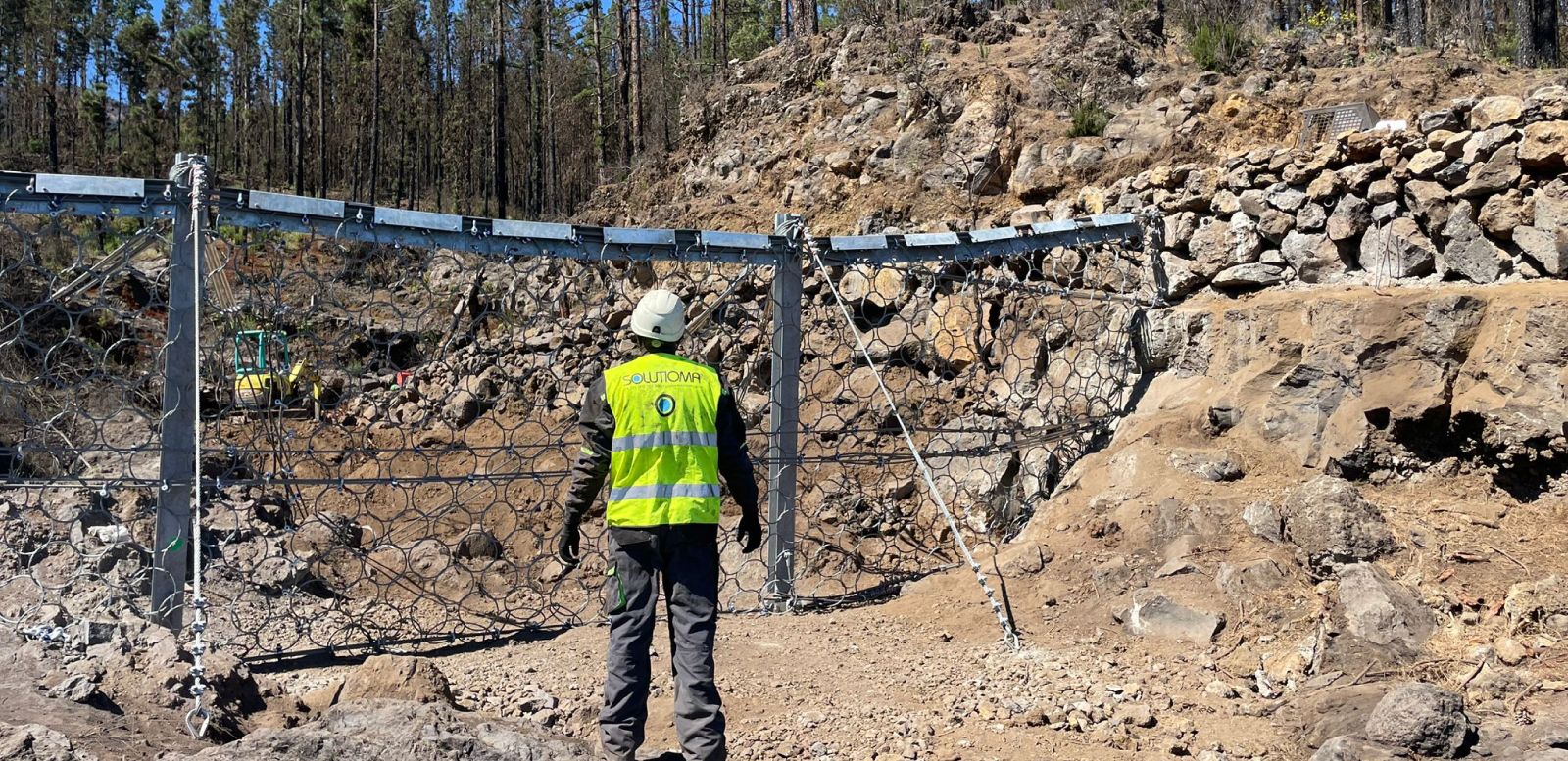
Ring mesh debris flow barriers that retain rocks, gravel and silt in torrents and protect roads, homes and reservoirs downstream.
- Over 30 years of experience
- Survey, design and execution with our own team and machinery
- Offices in Spain and Romania
Debris flow barriers for the hydrological correction of torrents and ravines
Debris flow barriers, also known as debris barriers or hydrological correction barriers, are flexible structures installed in torrents and ravines to retain the material carried by water. At Solutioma we design and install them as part of our rockfall protection systems against mudslides, debris flows and severe erosion.
Debris flow barriers are designed to withstand and contain the advance of large volumes of material, such as rocks, gravel, silt and all kinds of sediment in general, which can be displaced during extreme weather events or by changes in the natural landscape.

Is a torrent threatening a road or a home?
We study the catchment and propose the right debris flow barrier for it. You can also call us on +34 900 101 895.
Why install debris flow barriers?
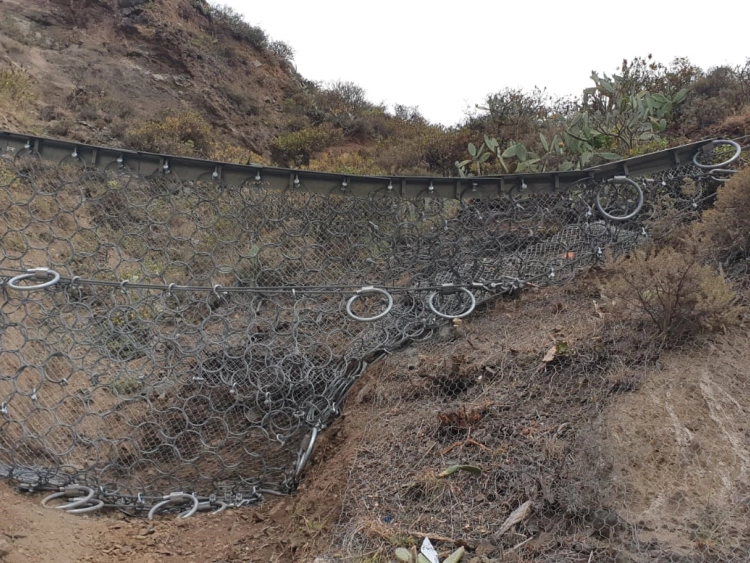
With extreme weather events becoming increasingly frequent, debris flow barriers form part of rockfall protection and also of erosion control, as hydrological correction works.
Debris flow barriers not only protect essential infrastructures such as roads, bridges, and buildings but also safeguard human lives and preserve the environment.
Design and features of debris flow barriers
Hydrological correction barriers are made up of a flexible ring mesh membrane, with high-strength steel wire, which protects people and infrastructure from possible uncontrolled hydrological movements.
Debris flow barriers offer the following advantages:
- They control and reduce the speed of water and, therefore, reduce the erosion caused by downstream currents.
- On hydrophobic soil and land subject to erosion, such as soil following a fire, the eroded materials are retained on the riverbeds. Upstream waters, mud, crushed ceramics and vegetable remains are deposited, creating a very fertile and damp space, which is very useful to help the herbaceous stratum introduced to subsequently act as a colonizer for the rest of the land.
- They prevent rocks, gravel, mud and debris of any type from being dragged into downstream reservoirs, thus reducing their capacity.
Installing debris flow barriers
The debris flow barriers that we install at Solutioma are placed in the flow path of debris flows or shallow landslides, often in natural trenches, channels or slope ramps.
Each barrier is adapted to the project's dimensions, the anticipated transported material and the expected flow volume, and incorporates specific energy absorption elements to restrict the flow.
Applications of debris flow barriers
At Solutioma we install these barriers in very different environments and adapt each one to the specific needs of the site. In mountain regions, for example, the priority is to prevent debris flows from blocking roads or damaging communities.
Protection against debris flow
Due to climate change, adverse weather events that can displace large volumes of mass are becoming increasingly frequent, especially in areas with steep slopes, where prevention through debris flow protection systems is needed.
A debris flow is a phenomenon in which masses of soil with water and fragmented rock rush down mountain slopes, carrying material along with them and accumulating in the valleys. It is particularly dangerous because of its rapid movement and because it often strikes without warning.
To deal with these phenomena, at Solutioma we use hydrological correction screens to control debris flow in torrents and ravines.
At Solutioma we study each catchment, design a bespoke barrier and install it with our own teams, using difficult access works and access by truck-mounted crane or helicopter when the terrain requires it, with respect for the environment.
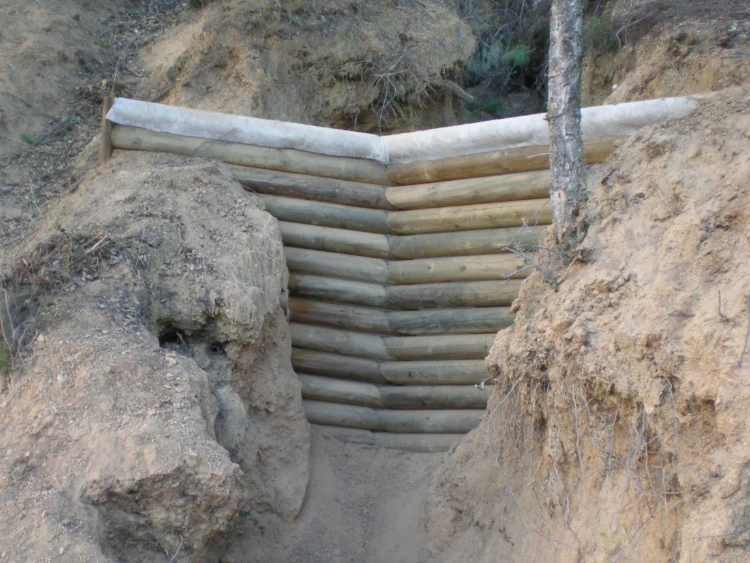
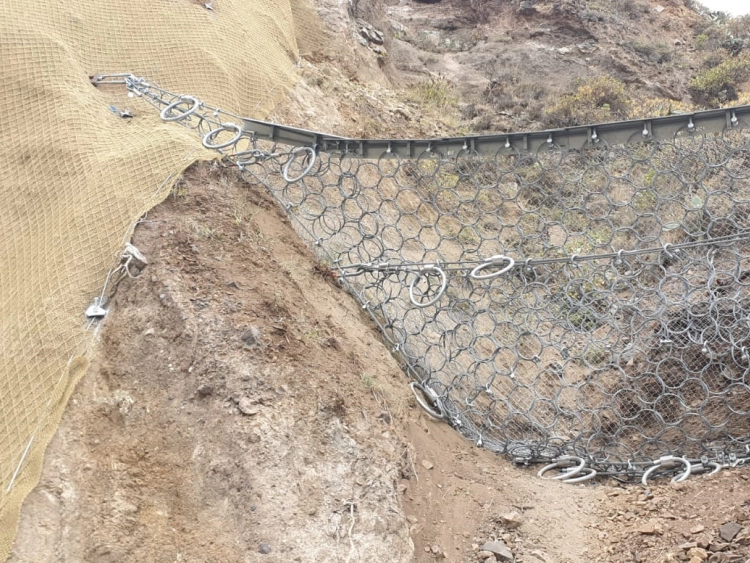
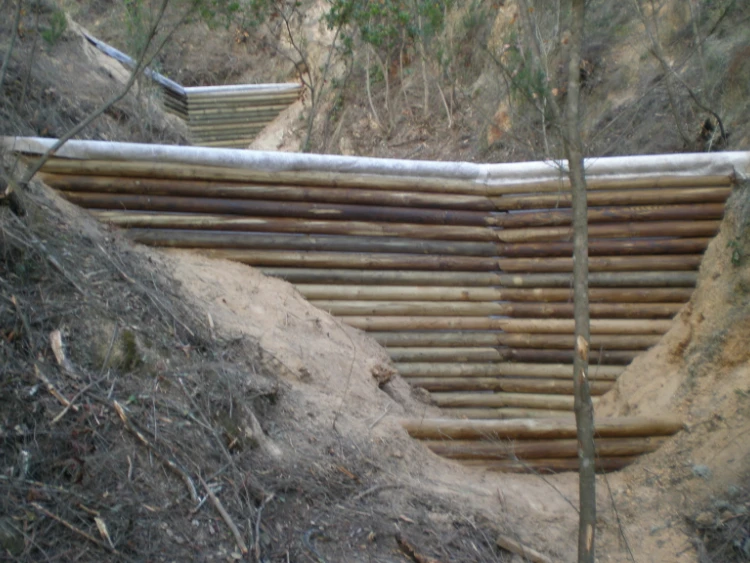
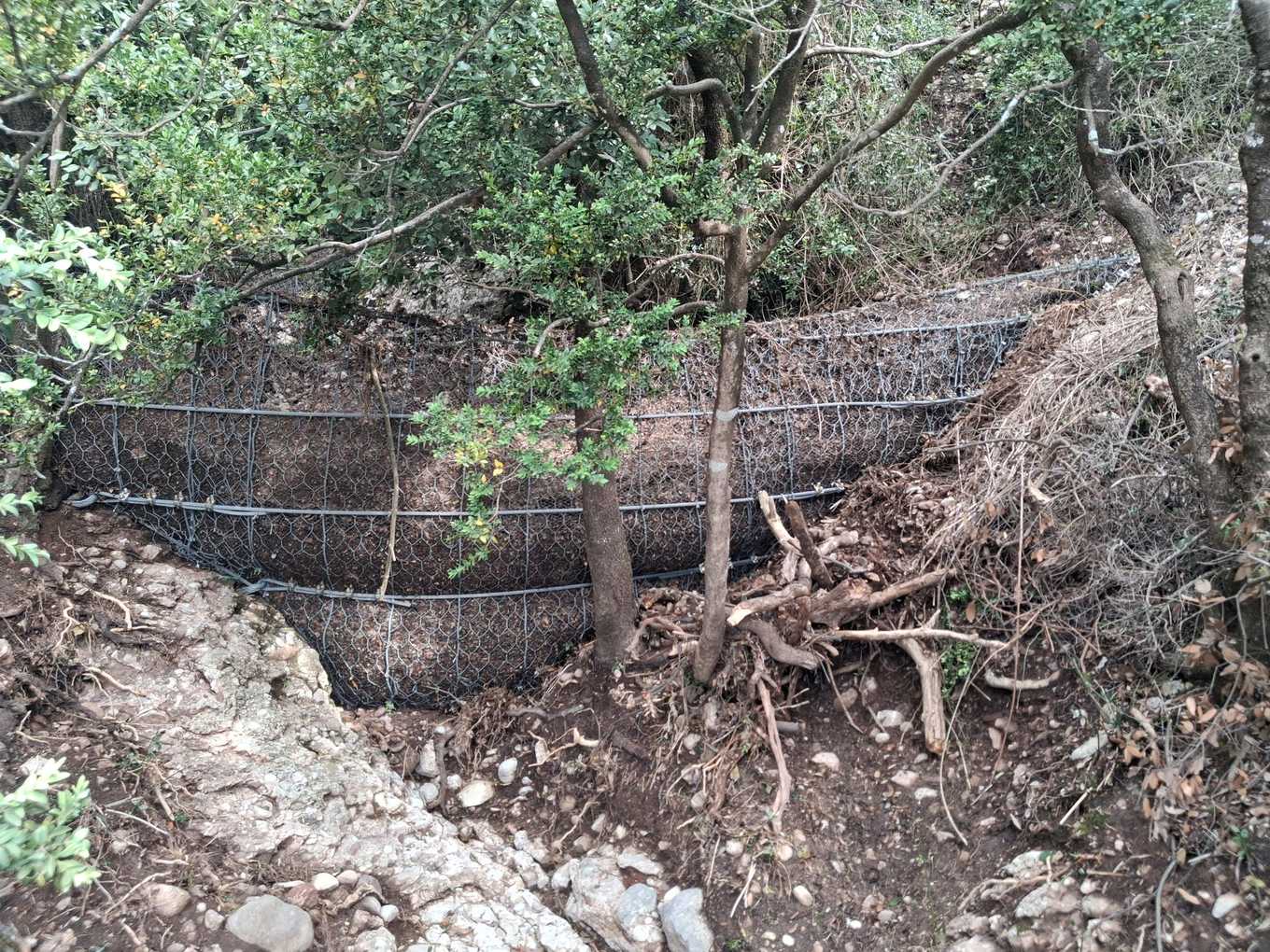
Debris flow barriers installed
Debris flow barriers installed
Frequently asked questions about debris flow barriers
Frequently asked questions about debris flow barriers
What is a debris flow barrier?
A debris flow barrier, or debris barrier, is a flexible structure placed in a torrent or ravine to retain the rocks, gravel, silt and plant debris carried by water and to protect whatever lies downstream.
The barriers consist of a flexible ring mesh membrane, with high-strength steel wire, and incorporate specific energy absorption elements to restrict the flow. Each barrier is adapted to the project's dimensions, the anticipated transported material and the expected flow volume; because of their membrane, they are also referred to as debris flow nets.
The name comes from the phenomenon they control: a debris flow is a mass of soil with water and fragmented rock that descends a mountain channel rapidly and often without warning. Against it, the barrier works as a hydrological correction structure: it stops the material in the channel before it reaches a road, a bridge, a home or a reservoir.
At Solutioma we design each barrier to suit the catchment and install it with our own teams. If you are concerned about a particular torrent, send us its location and a few photographs and we will assess it.
When are debris flow barriers needed?
Debris flow barriers are needed when a torrent or ravine can carry rocks, gravel and mud towards roads, bridges, buildings or reservoirs downstream, especially in mountain areas with steep slopes.
The adverse weather events that trigger these flows are becoming increasingly frequent. In mountain regions, debris flow mitigation usually focuses on preventing the material from blocking roads or damaging communities; the barrier is placed in the flow path of the debris flow or of shallow landslides, often in natural trenches, channels or slope ramps.
Another application is on hydrophobic, highly erodible ground, such as that left after a forest fire. There, the barriers retain eroded material in the gullies: silt and plant debris are deposited upstream, forming a fertile, moist area that later helps the herbaceous layer to colonise the rest of the ground. They also prevent sediment from reaching reservoirs and reducing their capacity.
At Solutioma we study the catchment and the exposed asset before proposing a barrier. Tell us what you need to protect and we will advise you without obligation.
How is a debris flow barrier installed?
A debris flow barrier is installed across the channel, within the flow path, and is fixed to the banks and bed of the torrent with anchors that transfer the forces to the ground.
The first step is to study the catchment: where the material comes from, what volume can be mobilised and what lies downstream. With that information, a section of the channel that allows the barrier to be properly anchored is chosen, and the barrier is sized to the project's dimensions, the anticipated transported material and the expected flow volume.
Next, the drilling and anchors are carried out, the ring mesh membrane is assembled with its cables and the energy absorption elements are installed. In long channels, several staggered flexible debris flow barriers can be more effective than a single large one.
The banks of a torrent rarely offer a working platform, so much of the work is carried out through difficult access works. At Solutioma we have our own teams and access by truck-mounted crane or helicopter when the terrain requires it.
What is the difference between a debris flow barrier and a dynamic rockfall barrier?
A dynamic rockfall barrier stops rock blocks falling down a hillside, whereas a debris flow barrier retains, within a channel, a mixture of water, soil, rock and plant debris that flows down continuously.
Dynamic rockfall barriers are placed in the fall path of the blocks and absorb their impact energy through the deformation of the barrier itself and its energy-dissipating elements. They are installed on the hillside, between the detachment zone and whatever needs protecting.
The debris flow barrier is placed in the torrent or ravine itself and receives a more distributed and prolonged thrust. As well as retaining material, it acts as a torrent control barrier with a hydrological correction function: it controls and reduces the speed of the water and reduces erosion in the channel downstream. That is why their location and anchoring differ, even though both are flexible structures.
At Solutioma we install both systems, which can be complementary when an area has both rockfall and active torrents. We help you decide which one your case needs after studying the site.
What happens when a sediment barrier fills up with material?
When a sediment barrier fills up, the retained material remains deposited upstream, and a decision has to be made on whether to remove it to recover capacity or to leave it in the channel. The decision depends on the purpose of the barrier.
If the barrier protects a road, a home or a reservoir, it is important to keep capacity for the next event, so the material is usually removed after major floods. If the aim is erosion control, the deposit can serve its purpose: the silt and plant debris retained form a fertile, moist area that encourages the establishment of the herbaceous layer.
In any case, debris containment barriers should be inspected periodically and, above all, after episodes of heavy rain. The inspection checks the ring mesh membrane, the cables, the anchors and the energy absorption elements.
At Solutioma we carry out both works and maintenance, so we can take care of the inspection and the removal of material when needed. Ask us about the most suitable approach for your barrier.
How much does a debris flow barrier cost?
The price of a debris flow barrier is not a fixed figure: it is calculated for each channel, after studying the catchment and the asset to be protected.
The factors include the width of the channel section, the expected volume of material, the dimensions of the membrane, the number and depth of the anchors and the number of barriers required. A small catchment and a large one do not produce the same phenomenon or call for the same solution.
Access is often decisive. Two torrents of the same width can have very different costs if one can be reached with machinery and the other only with rope access, with the materials transported by truck-mounted crane or helicopter. The maintenance planned after installation also counts.
We work in Spain and internationally, with offices in Lleida, Madrid, the Canary Islands, Jaén, Gipuzkoa and Bucharest. To prepare an assessment, please send us the location, photographs of the channel and, if available, the project documentation, or call us on +34 900 101 895.
Contact
Why entrust your debris flow barriers to Solutioma?
At Solutioma we study, design and install debris flow barriers to protect roads, communities and reservoirs in torrents and ravines, with people who have more than 30 years of experience in the sector, rope access teams and our own machinery.
If you would like to discuss any questions with our technical team or request a quote for installing debris flow barriers, please fill in the form below. If you prefer, you can also call us on +34 900 101 895; we will be happy to assist you.
- +34 900 101 895
Call us if you prefer - solutioma@solutioma.com
Write to us directly - Over 30 years of experience
Survey, design and execution with our own team and machinery - Offices in Spain and Romania
Lleida, Madrid, Canary Islands, Jaén, Gipuzkoa and Bucharest