
Slope stabilisation
Drainage
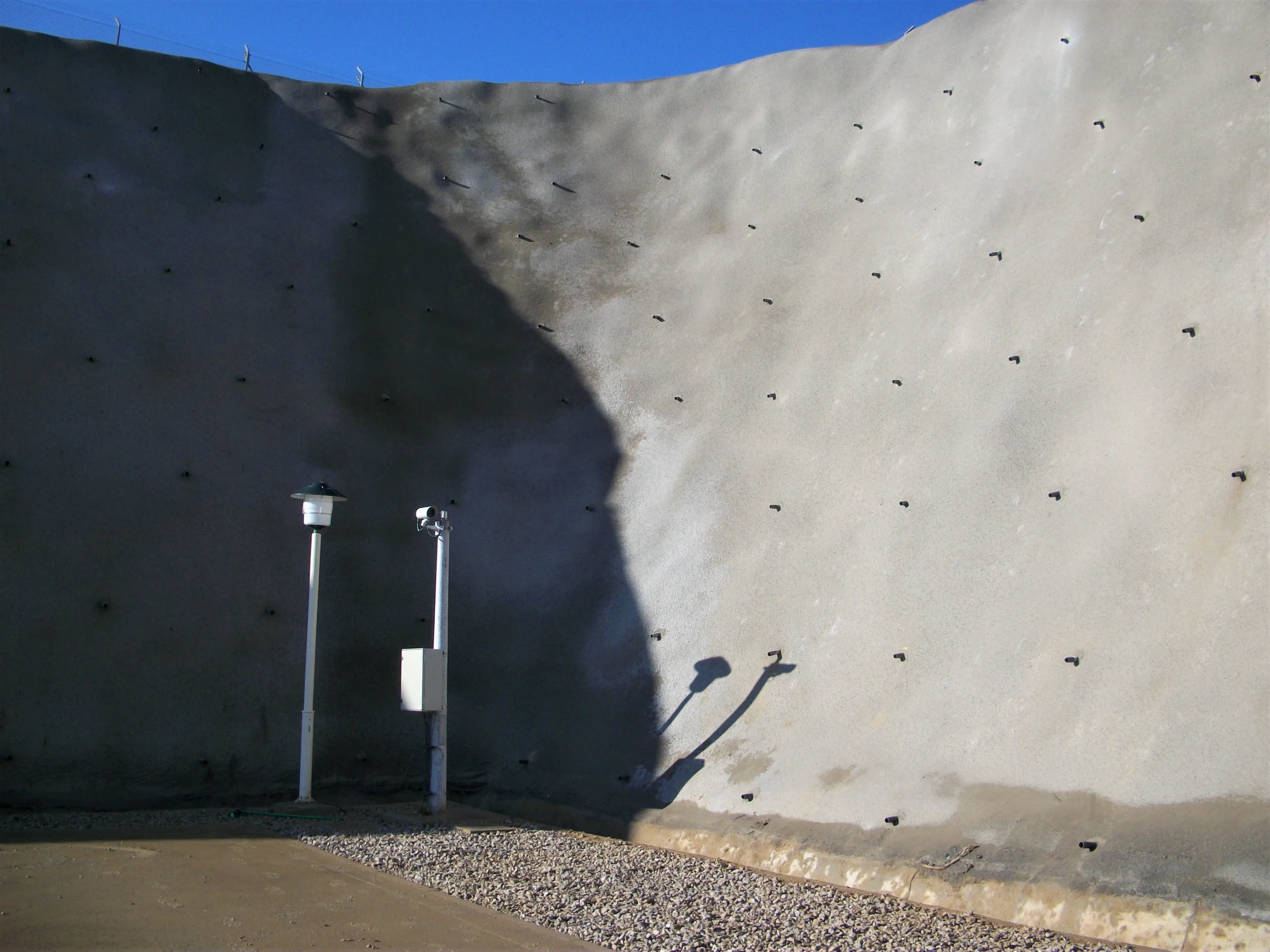
Slope drainage with wick drains, weep holes and horizontal drains to remove water from behind the facing and prevent excess pressure.
- Over 30 years of experience
- Survey, design and execution with our own team and machinery
- Offices in Spain and Romania
Why is slope drainage important for stability?
Slope drainage is the set of drains, wick drains and weep holes that remove water from the ground to prevent excess pressure and landslides. At Solutioma, we design and install drainage systems as part of slope stabilisation, as a complement to sprayed concrete and Soil Nailing, so that each slope and its retaining system work properly.
Every drainage project is unique. That is why, at Solutioma, we propose bespoke solutions, adapted to the ground and to the specific needs of each client.
Does your slope hold water or show seepage?
We study the slope and propose the right drainage system for you. You can also call us on +34 900 101 895.
Features of a slope drainage system
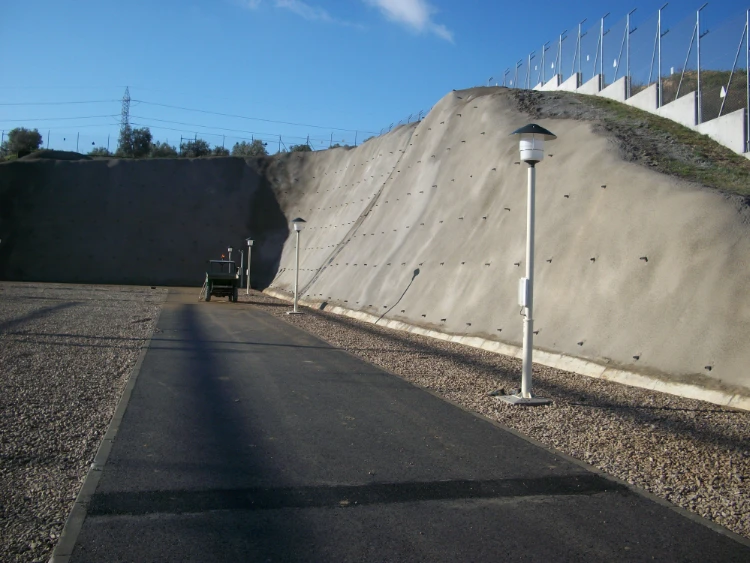
An efficient drainage system is vital for the structural integrity of slopes. Water accumulation in the slope can increase hydrostatic pressure, which can cause landslides and other serious problems.
At Solutioma, we design drainage systems that manage the flow of water effectively and protect the surrounding infrastructure.
In addition, when installing drains, we work to minimise the environmental impact and to offer sustainable, environmentally friendly solutions.
Types of slope drainage: wick drains, weep holes and horizontal drains
The drainage systems we install at Solutioma are adapted to the ground and the project: wick drains, weep holes and horizontal drains. All of them remove water from behind the facing and prevent excess pressure, maintaining the stability of the slope and the surrounding areas.
Installation and maintenance of drainage systems
At Solutioma, we offer a comprehensive service for drainage systems, covering study, design, installation and maintenance. Our methodology begins with a thorough design phase adapted to each client.
The design phase is crucial because it allows the drainage solution to be adapted to the needs and characteristics of each setting.
Design and installation of the drainage system
Each project at Solutioma receives an individual approach. Our technical team analyses the ground to design the drainage system that each slope needs, and our own teams carry out the installation efficiently and safely, with rope access where the site requires it.
At Solutioma, we define the appropriate drainage in each case, whether wick drains, weep holes or horizontal drains, to remove water from behind sprayed concrete or Soil Nailing facings and prevent excess pressure.
Slope drainage projects we have completed
Slope drainage projects we have completed
Frequently asked questions about slope drainage
Frequently asked questions about slope drainage
What is a slope drainage system?
A slope drainage system is the set of elements that collect and remove water from the ground so that it does not build up inside the slope or behind its facing. Its purpose is to reduce hydrostatic pressure and, with it, the risk of landslides.
Water is one of the main causes of instability: it adds weight to the ground, pushes it from within and, in soils, reduces its strength. Slope drains give the water a controlled outlet, with a known path to a safe discharge point, instead of letting it flow through cracks and planes of weakness.
Drainage on a slope is provided by different elements depending on the depth at which action is needed: wick drains, weep holes and horizontal drains. They are often combined on the same slope and defined together with the stabilisation system.
At Solutioma, we study where the water comes from, design the slope drainage and install it on site with our own machinery. If your slope shows damp patches or springs, we can study which solution suits it best.
When does a slope need drainage?
Drainage is needed when rainwater or seepage can build up in the ground and increase hydrostatic pressure, and whenever the slope is covered with sprayed concrete or reinforced with Soil Nailing.
If a slope has no drainage, the water creates thrusts for which the stabilisation system is not designed. On covered slopes, the surface also prevents water from escaping on its own, and damp patches, cracks or even detachment of the facing may appear.
A drainage system for slope stability is a common need on roads and railways: on cut slopes and embankments, water from the hillside and from the carriageway meets at the foot of the slope, which is why embankment drainage is so important. Other signs of insufficient drainage are springs at the base, erosion of the toe, persistent damp patches or fines being washed out after rain.
That is why, at Solutioma, we define the drainage together with the stabilisation system rather than as a later addition. If you are concerned about a particular slope, send us a few photographs and we will give you an initial technical assessment.
How do horizontal drains work on slopes?
Horizontal drains are long, sub-horizontal boreholes sloping slightly outwards, in which a perforated drain pipe is placed to collect water from inside the ground and carry it out of the slope by gravity.
In Spain they are also known as California drains, and in the UK they are sometimes called raking drains. They are used when the water comes from deep zones, for example from a high water table or from permeable layers feeding the slope, and weep holes or wick drains are not enough to reduce the hydrostatic pressure.
Their design requires knowledge of the geology and the water regime of the slope: the length, inclination, spacing and type of pipe are defined in the project, as is the point to which the collected water will be discharged. Installation requires drilling equipment able to work on the face, often in positions with difficult access.
At Solutioma, we install horizontal drains with our own machinery and, where the face requires it, with rope access teams. If persistent springs appear on your slope, we will help you assess whether this is the right answer for slope stability.
What is the difference between weep holes, wick drains and horizontal drains?
The difference lies in the depth at which they work: weep holes release water that has built up just behind the facing, wick drains carry it from the nearby ground or fill, and horizontal drains collect it from deep zones of the slope.
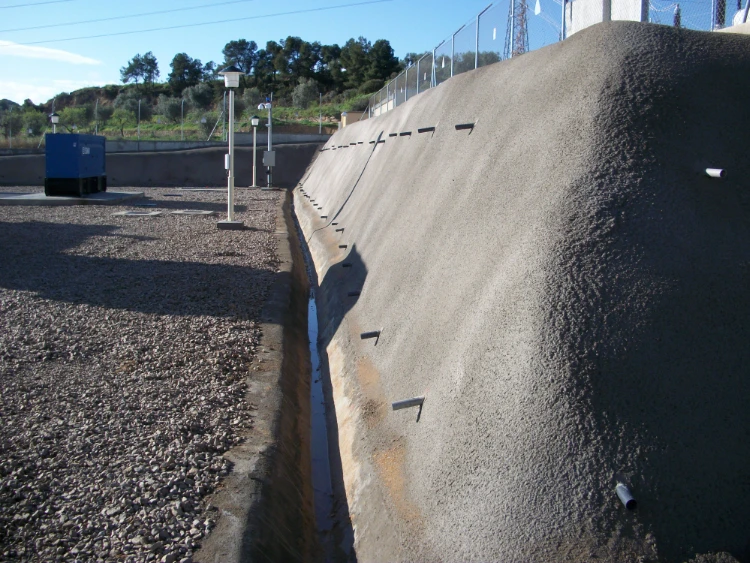
A weep hole is an opening or small pipe that passes through the facing, such as a layer of sprayed concrete or a wall, with the inclination needed for the water to drain out by gravity. For effective weep hole drainage, it should be protected with a filter element that prevents fines from being washed out, because a blocked weep hole no longer does its job.
Wick drains collect water from the ground closest to the facing and carry it to the outlet points; horizontal drains, on the other hand, are long boreholes reserved for deep water. These are the main types of slope drainage system: on shotcreted slopes or those reinforced with Soil Nailing, weep holes and wick drains are usually combined, and horizontal drains are added when the water comes from inside.
At Solutioma, we define the position and number of weep holes, wick drains and horizontal drains according to the needs of each slope. If you have a facing that holds water or shows damp patches, our technical team can inspect it.
Do slope drains need maintenance?
Yes. Slope drains need regular inspections, because over time they can become blocked with fines, roots or sediment and stop removing the water for which they were designed.
When a drain stops working, water pressure builds up again behind the facing or inside the ground, and the slope loses part of the safety margin that the system provided. It is usually a silent deterioration: the drain is not seen to fail, but damp patches, springs in other places or stains on the concrete appear.
Maintenance of slope drainage consists of inspecting the outlets, checking that the water flows, removing blockages and, if necessary, cleaning or replacing damaged elements. It is advisable to schedule these checks as part of the regular inspections of the slope and, above all, after episodes of heavy rain.
At Solutioma, we carry out both new works and maintenance of drainage systems. When the drains are in areas with difficult access, we work with rope access and work-at-height teams. If your drains no longer discharge as they used to, we recommend an inspection.
How much does slope drainage cost?
The cost of slope drainage depends on the type and number of drains, their length and the access conditions, so it is calculated for each specific case.
Fitting weep holes in an accessible facing is not the same as installing deep horizontal drains, which require drilling equipment. The amount of water to be removed, the distance to the discharge point and whether the drainage is carried out together with another stabilisation system, as an integrated slope protection and drainage system that allows resources to be shared on site, also play a part.
Access is another decisive factor: on very high slopes or where there is no route for machinery, rope access teams, a truck-mounted crane or even a helicopter may be needed. On the other hand, well-designed slope drainage solutions help to avoid later repairs to the facing or to nearby infrastructure.
To assess your case, send us the location, a few photographs of the slope and, if you have them, the project data or the geotechnical report. We work in Spain and internationally, with offices in Lleida, Madrid, the Canary Islands, Jaén and Gipuzkoa, and you can also call us on +34 900 101 895.
Contact
Why entrust the drainage of your slope to Solutioma?
At Solutioma, we study, design and install slope drainage as part of ground stabilisation, with people who have more than 30 years of experience in the sector, rope access teams and our own machinery. If you would like to discuss any questions with our technical team or request a quote for draining your slope, please fill in the form below. If you prefer, you can also call us on +34 900 101 895; we will be happy to assist you.
- +34 900 101 895
Call us if you prefer - solutioma@solutioma.com
Write to us directly - Over 30 years of experience
Survey, design and execution with our own team and machinery - Offices in Spain and Romania
Lleida, Madrid, Canary Islands, Jaén, Gipuzkoa and Bucharest