Erosion control
Three-dimensional geomat
Three-dimensional geomat or 3D erosion control mat: it protects the slope from day one, retains topsoil and supports hydroseeding.
- Over 30 years of experience
- Survey, design and execution with our own team and machinery
- Offices in Spain and Romania
Three-dimensional geomat: an erosion control mat for slopes
A three-dimensional geomat is a 3D mat of interwoven synthetic filaments that protects the slope against water and wind erosion and supports vegetation. At Solutioma, as specialists in erosion control projects, we install it as a comprehensive system to protect and revegetate slopes.
The filaments of the mat, usually polypropylene or polyamide stabilised against UV radiation, interweave to form a strong, permeable and durable three-dimensional net, manufactured in thicknesses of 8 to 20 mm.
The design of the mat allows fines to be retained: it becomes integrated into the ground and prevents the washing away caused by wind and rain.
Is your slope losing soil when it rains?
We will tell you whether a three-dimensional geomat is enough or whether it needs mesh reinforcement. You can also call us on +34 900 101 895.
Features and benefits of the three-dimensional geomat
Three-dimensional geomats are characterised by their adaptability to different topographies, their resistance to adverse environmental factors and their ease of installation. These are their main features and advantages:
- Permanent protection against erosion caused by water and wind from the moment of its installation.
- Promotes rapid and homogeneous vegetation growth.
- Root reinforcement system.
- High permeability that increases water retention in the soil.
- Great flexibility and high adaptation to the terrain’s morphology.
- Support for hydroseeding and landscape integration.
- Resistant to chemical and biological agents.
Applications of the three-dimensional geomat
When do we incorporate the three-dimensional geomat?
At Solutioma we study the area, define its conditions and identify the problem before incorporating the three-dimensional geomat in:
- Landscaping works.
- Restoration works in landfills, spoil heaps, mines, etc.
- Erosion protection on excavation slopes.
- Protection of slopes in linear works.
The material from which three-dimensional geomats are made is particularly suitable for areas where erosion is significant and soil conditions are unfavourable for complete vegetation to become established.
Environmental impact of the three-dimensional geomat
Integration with the environment
Three-dimensional geomats not only protect the soil against erosion but also provide significant environmental benefits. They allow vegetation to become integrated, improving the appearance and health of the surrounding ecosystem. This aspect is of utmost importance for projects seeking a balance between infrastructure development and environmental conservation.
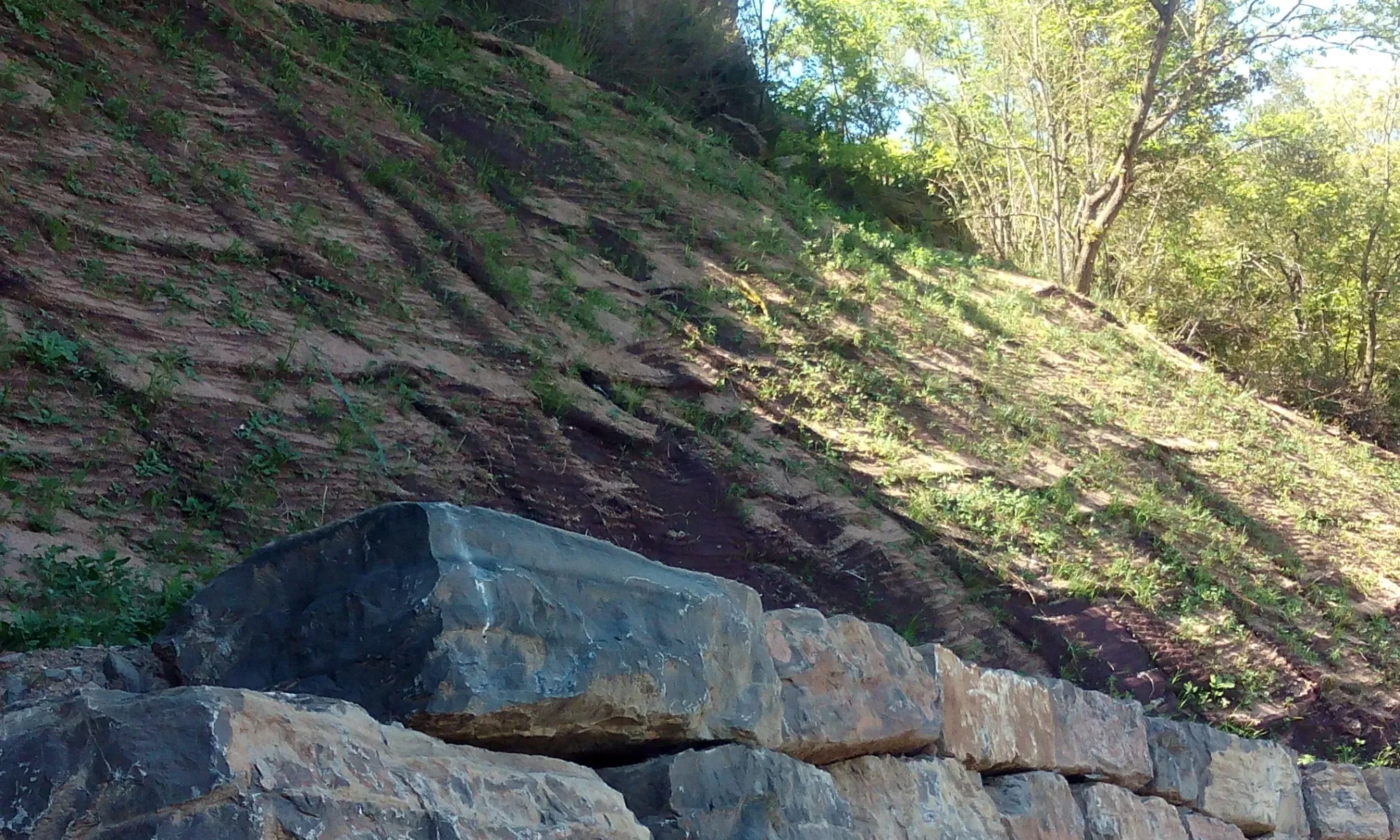
Three-dimensional geomats have a hollow internal space that retains topsoil and allows a network of roots and stems to develop once hydroseeding has been applied over them. Their effect is very useful and effective on sloping surfaces. This network of mat, soil, roots and stems provides a comprehensive erosion control system.
Installation and maintenance of the three-dimensional geomat
How the three-dimensional geomat is installed
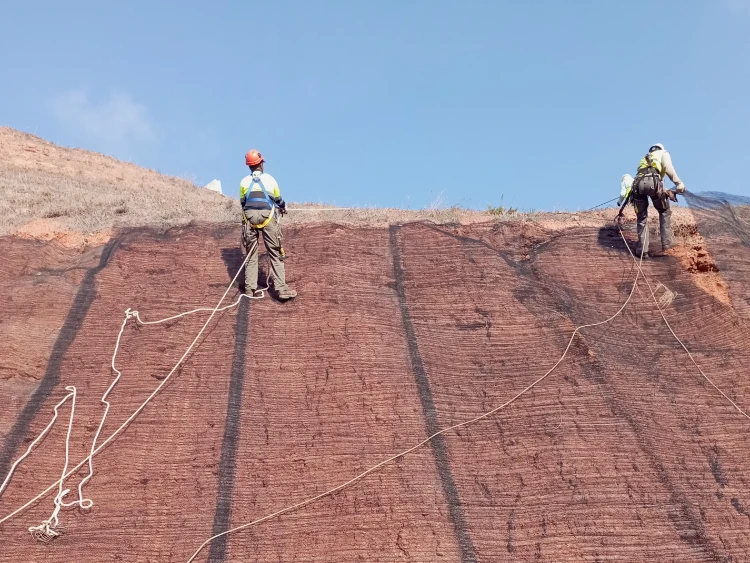
Installing a three-dimensional geomat involves preparing the ground, laying and anchoring the mat and, usually, applying hydroseeding over it afterwards. At Solutioma we take care over every phase to optimise the performance and durability of the system.
Technical considerations for each project
Adaptability and tailored design
Every project has its own challenges and requirements. Three-dimensional geomats offer great adaptability and can be adjusted to the specific needs of each site. At Solutioma we work closely with our clients to design tailored solutions that meet the technical and environmental requirements of each situation.
Three-dimensional geomats are often combined with hydroseeding and with slope stabilisation systems such as double-twist mesh or reinforced mesh, in the geomat with double-twist mesh solution. This reinforces the system, which gains tensile strength and avoids possible tears in the geomat caused by localised accumulations of material.
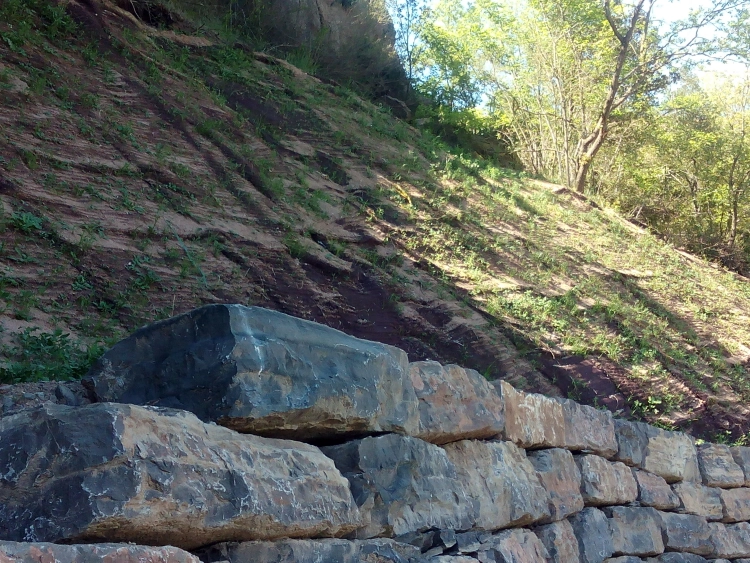
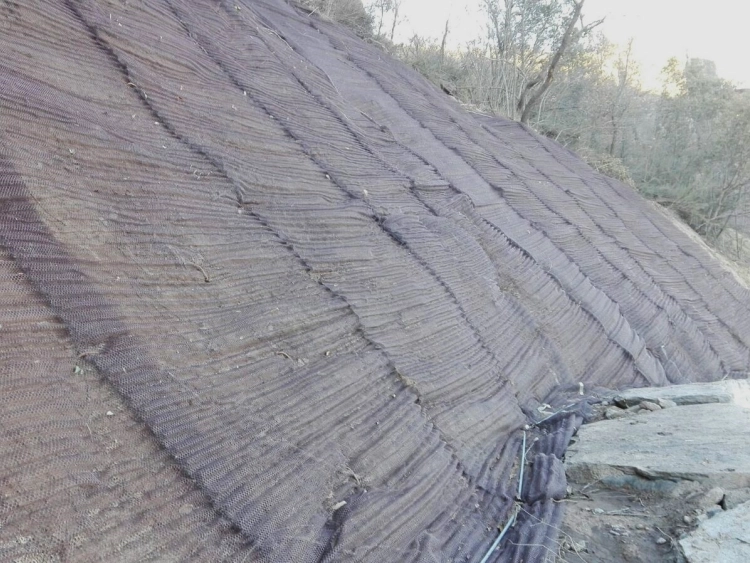
Three-dimensional geomats installed
Three-dimensional geomats installed
Frequently asked questions about the three-dimensional geomat
Frequently asked questions about the three-dimensional geomat
What is a three-dimensional geomat?
A three-dimensional geomat, or 3D geomat, is a mat of interwoven synthetic filaments that forms a net in three dimensions and is laid over the slope to protect it from erosion and support vegetation. It is also known simply as a geomat or as a three-dimensional erosion control mat.
According to our technical data sheet, the filaments are usually made of polypropylene or polyamide, stabilised against UV radiation, and the mat is manufactured in thicknesses of 8 to 20 mm. The result is a strong, permeable and durable net that is also resistant to chemical and biological agents.
What sets it apart from a flat mesh is its hollow internal space: it retains topsoil and fines and, after hydroseeding, allows roots and stems to interweave with the filaments. This network of mat, soil, roots and stems protects the slope permanently.
At Solutioma we study the area, define its conditions and select the right mat for each slope. If yours loses soil every time it rains, our technical team will tell you whether this is the solution you need.
What is a three-dimensional geomat used for?
Three-dimensional geomats are used to protect slopes against water and wind erosion from the moment they are installed and to help revegetate them. They are chosen when the problem on the slope is superficial: loss of soil and fines, not ground instability.
According to our technical data sheet, the usual applications of an erosion control geomat are slope protection on linear infrastructure works, erosion protection on excavation slopes, restoration works in landfills, spoil heaps and mines, and landscaping works.
The material is particularly suitable where erosion is significant and soil conditions are unfavourable for complete vegetation to become established. On those slopes, geomat erosion control works by retaining the topsoil, reducing the amount that has to be brought in and promoting rapid, uniform growth of vegetation.
Before proposing it, at Solutioma we check whether the slope needs only surface protection or also reinforcement. Tell us what is happening on your slope and we will advise you on the most suitable solution.
How is a 3D geomat installed on a slope?
A three-dimensional geomat is installed in three phases: ground preparation, laying and anchoring the mat on the slope and, usually, applying hydroseeding to revegetate it.
Preparation involves regularising the surface and removing loose material, so that the mat stays in contact with the ground over its entire area. The geomat is then rolled out and anchored to the slope; its great flexibility allows it to adapt to the morphology of the ground, even on irregular surfaces.
Hydroseeding is what turns the mat into a living system: the topsoil and seeds are held in the hollow internal space and, as they germinate, the roots interweave with the filaments. Erosion protection begins on the day of installation, without waiting for the vegetation to grow.
At Solutioma we carry out the installation with our own rope access teams and, where the slope has no track, with access by truck-mounted crane or helicopter. Ask us for a technical visit if you would like to know how the work would be carried out on your site.
What is the difference between a three-dimensional geomat and a geomat with double-twist mesh?
The three-dimensional geomat is installed on its own when the slope only needs erosion protection and support for vegetation; the geomat with double-twist mesh adds an anchored double-twist mesh that provides tensile strength and surface stabilisation.
The three-dimensional geomat has no structural function: it protects the surface and retains the soil, but it does not hold stones or stop ground movement. If material accumulates at specific points on the slope or there is a risk of small rockfalls, the mesh reinforces the system and prevents possible tears in the mat.
Where the slope has larger volumes of unstable material, the mat is combined with a high-resistance membrane in the geomat with high-resistance membrane solution, anchored down to sound rock. All three solutions share the anti-erosion function; what changes is their holding capacity.
At Solutioma we study the slope before recommending one or the other, so that we neither install unnecessary reinforcement nor fall short. Send us a few photographs and we will tell you which system suits your case.
Are a 3D erosion control mat and a three-dimensional geomat the same thing?
Yes. In erosion control, 3D erosion control mat, three-dimensional net, geomatting and three-dimensional geomat are different names for the same product: a mat of synthetic filaments interwoven in three dimensions. Some manufacturers also market it as a turf reinforcement mat.
The name varies with the manufacturer or the project, but the function is the same: to retain topsoil and fines in its hollow internal space, prevent the washing away caused by wind and rain and support vegetation. The geomat we install is highly permeable, increases water retention in the soil and is resistant to chemical and biological agents.
It should not be confused with a metal mesh, such as double-twist mesh, which retains rock fragments and works in tension. Nor is it a geomembrane, which is an impermeable sheet: the three-dimensional net is permeable and lets water through.
If any of these names appears in your project, at Solutioma we help you interpret the specification and choose the right thickness. Contact us without obligation.
How much does it cost to install a three-dimensional geomat?
The geomat price is calculated for each slope, because it depends on the area, the thickness of the mat, the associated hydroseeding and, above all, access to the work area.
The area and thickness determine the amount of material; the thickness is chosen according to the topsoil to be retained, the slope angle and its exposure. Ground preparation, anchoring and hydroseeding complete the main cost item, and if the slope needs mesh reinforcement, the quote changes.
Access has a major impact on the price: working from a track is not the same as working on a slope that can only be reached with rope access, a truck-mounted crane or a helicopter. One point in the mat's favour is that it reduces the amount of topsoil that has to be brought onto the slope.
We work in Spain and internationally, with offices in Lleida, Madrid, the Canary Islands, Jaén, Gipuzkoa and Bucharest. To prepare a quote, please send us the location, the approximate area and a few photographs of the slope, or call us on +34 900 101 895.
Contact
Why entrust your three-dimensional geomat to Solutioma?
At Solutioma we study, design and install three-dimensional geomats to protect slopes against erosion and revegetate them, with people who have more than 30 years of experience in the sector, rope access teams and our own machinery.
If you would like to discuss any questions with our technical team or request a quote for installing a three-dimensional geomat, please fill in the form below. If you prefer, you can also call us on +34 900 101 895; we will be happy to assist you.
- +34 900 101 895
Call us if you prefer - solutioma@solutioma.com
Write to us directly - Over 30 years of experience
Survey, design and execution with our own team and machinery - Offices in Spain and Romania
Lleida, Madrid, Canary Islands, Jaén, Gipuzkoa and Bucharest