
Rockfall protection
Double-twist mesh
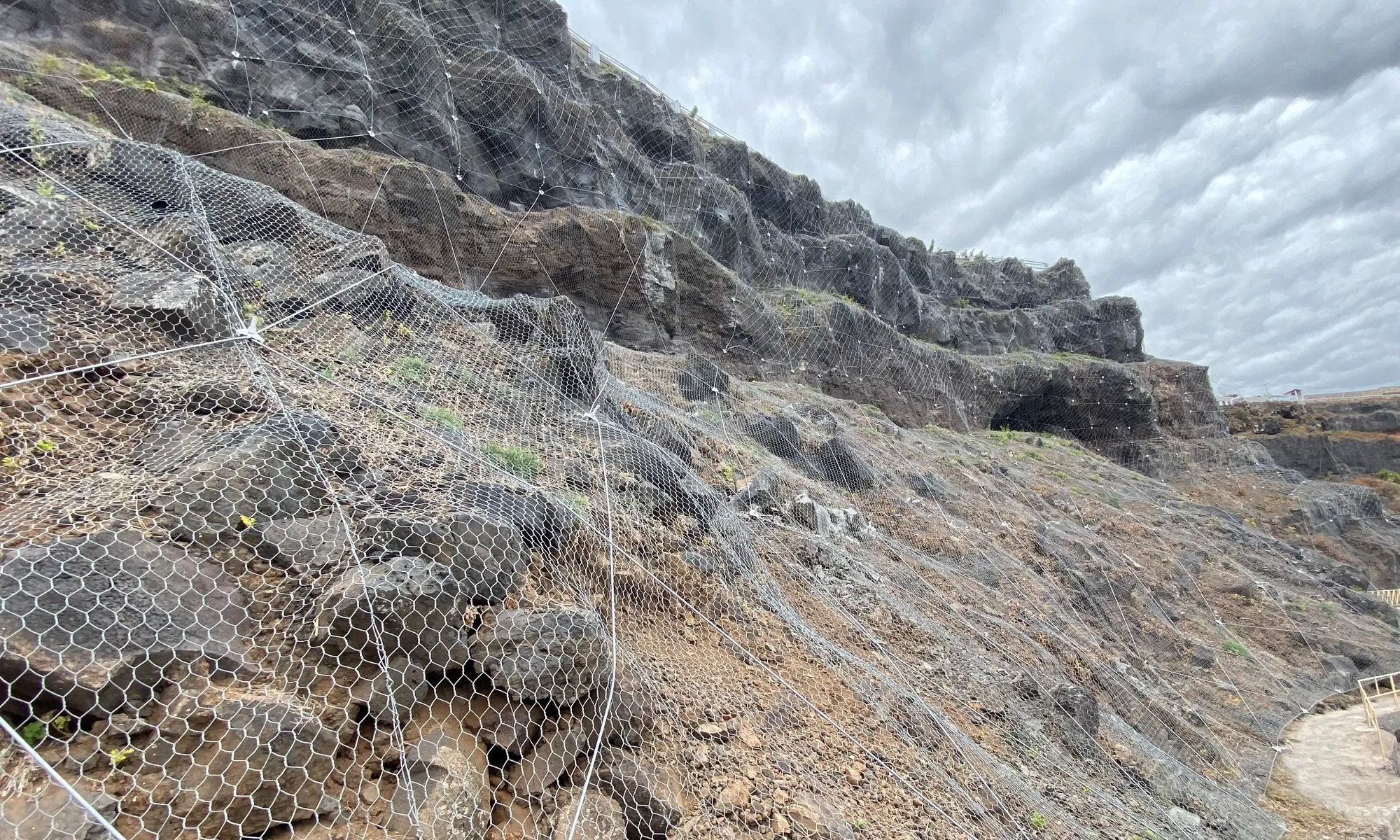
We install galvanised double-twist mesh on slopes: suspended mesh, mesh traps or reinforced mesh with anchors and cables.
- Over 30 years of experience
- Survey, design and execution with our own team and machinery
- Offices in Spain and Romania
Double-twist mesh for slopes: efficient and durable rockfall protection
Double-twist mesh is a hexagonal lattice of galvanised steel wire that is installed over a slope to retain or guide small rockfalls and protect roads, railways and infrastructure. At Solutioma we install it for slope stabilisation and rockfall protection.
Thanks to its versatility, double-twist mesh is a common tool in rockfall prevention and in the protection of infrastructure and natural areas.
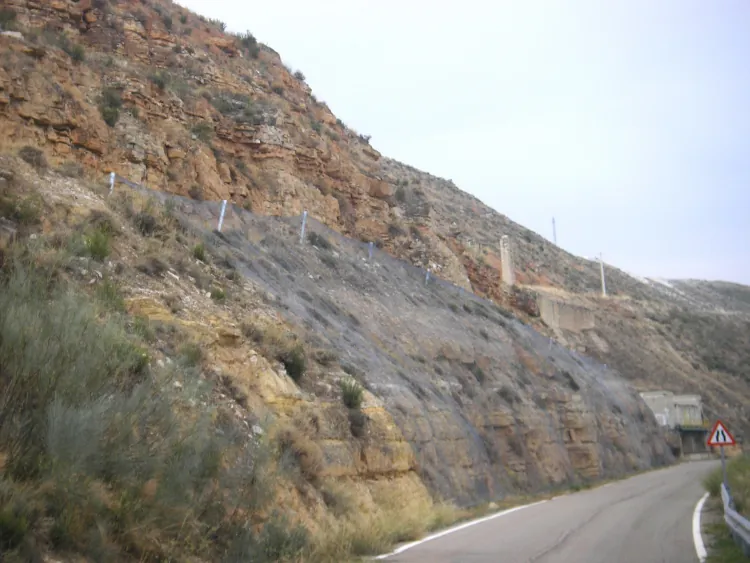
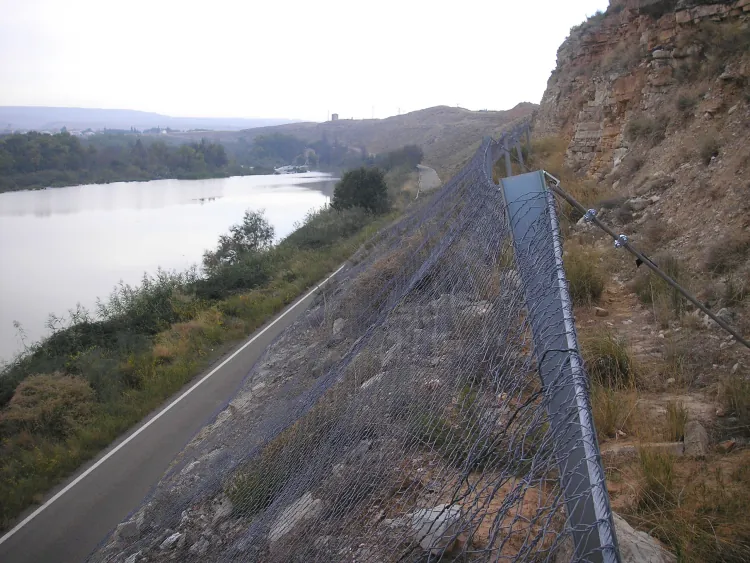
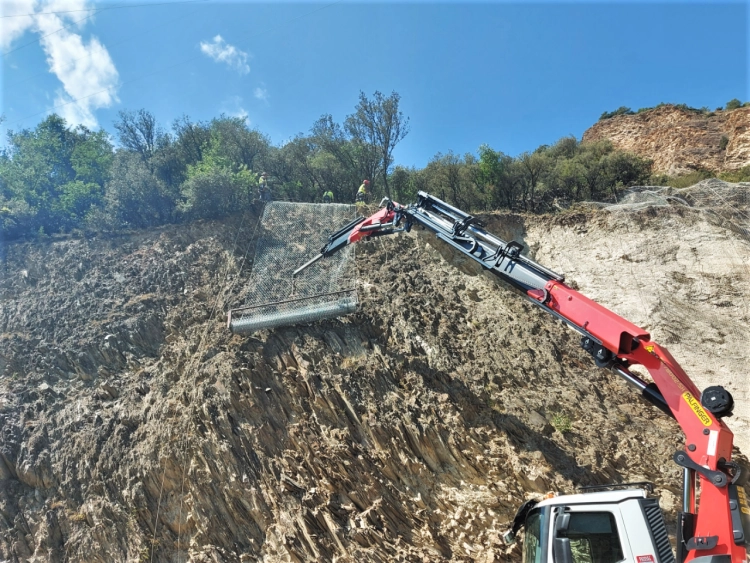
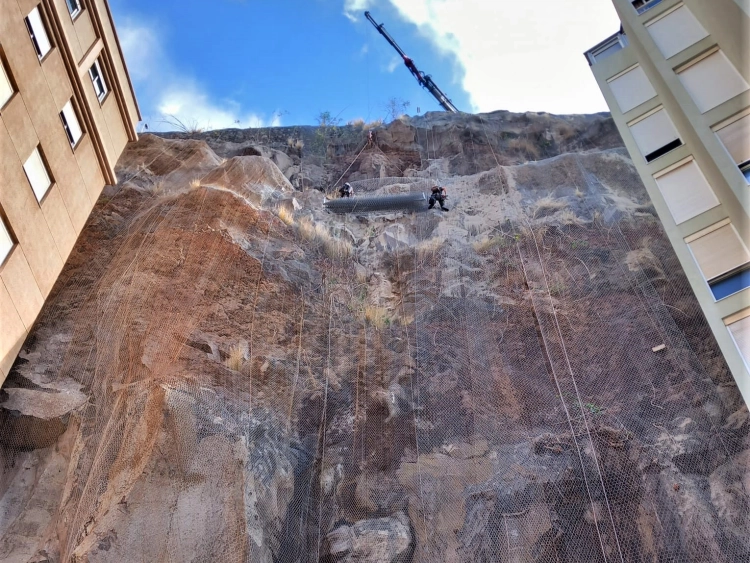
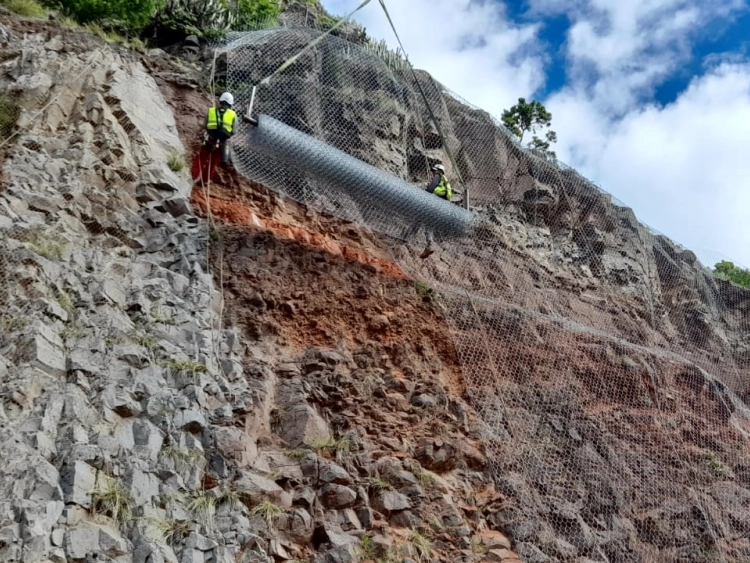
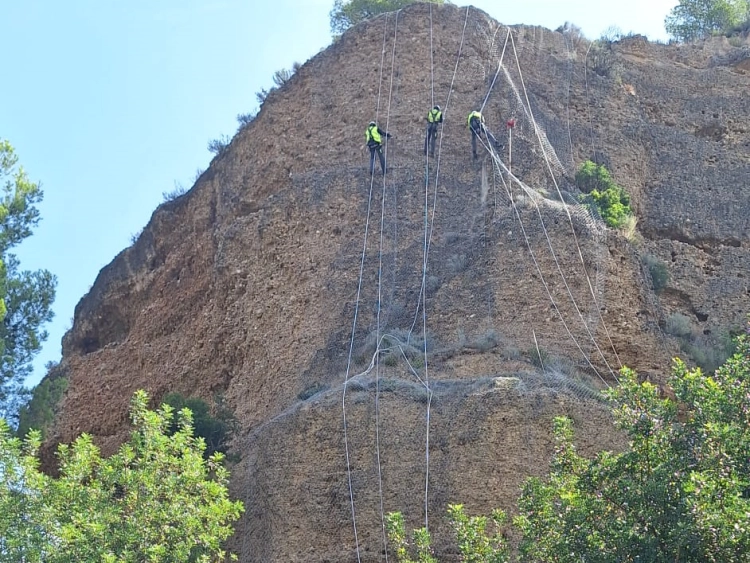
Are stones falling from your slope into the ditch or onto the road?
We will tell you which double-twist mesh your slope needs and prepare an assessment for you. You can also call us on +34 900 101 895.
Double-twist mesh design: a hexagonal lattice of galvanised steel
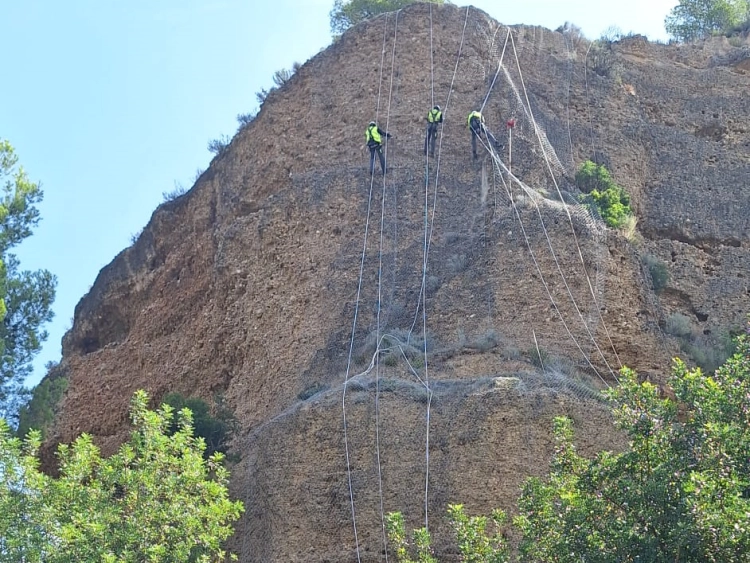
In general, double-twist meshes are systems that retain or direct small rockfalls of blocks larger than the mesh opening, and protect the surrounding area from the reach of these blocks.
Double-twist mesh consists of interwoven galvanised steel wires that form a hexagonal structure, generally of the 8x10 type with 2 to 2.7 mm wire in suspended mesh. This configuration gives the mesh flexibility and allows it to adapt to irregularities in the terrain.
Double-twist mesh can be combined with erosion control systems, as on its own it does not prevent the loss of fines from the slope.
Suspended double-twist mesh
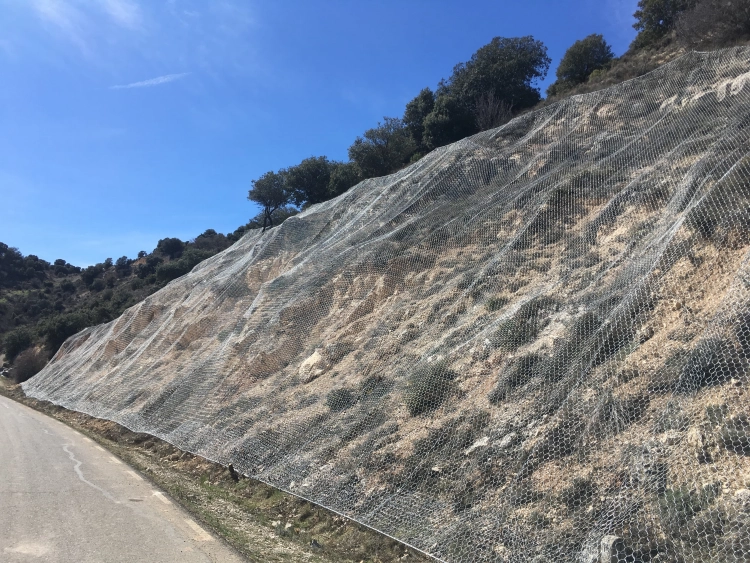
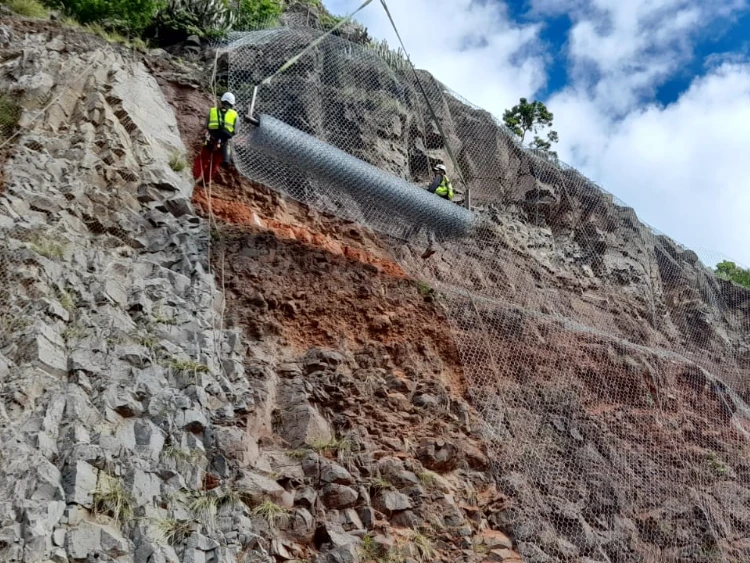
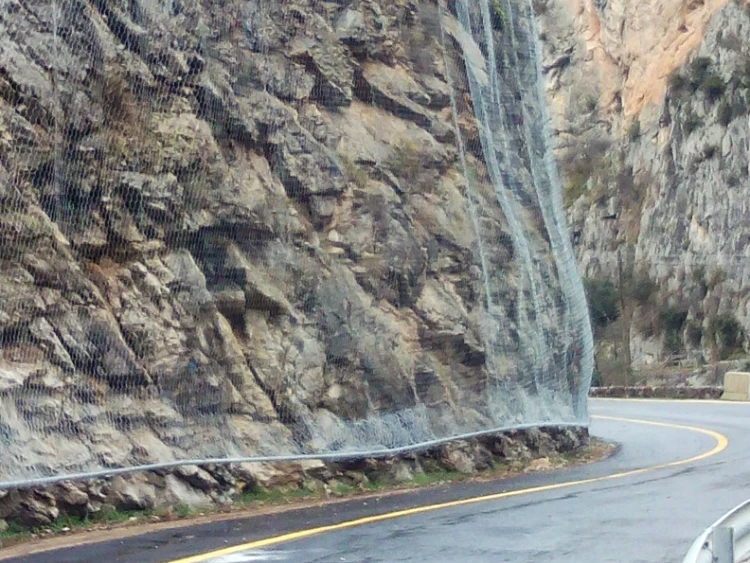
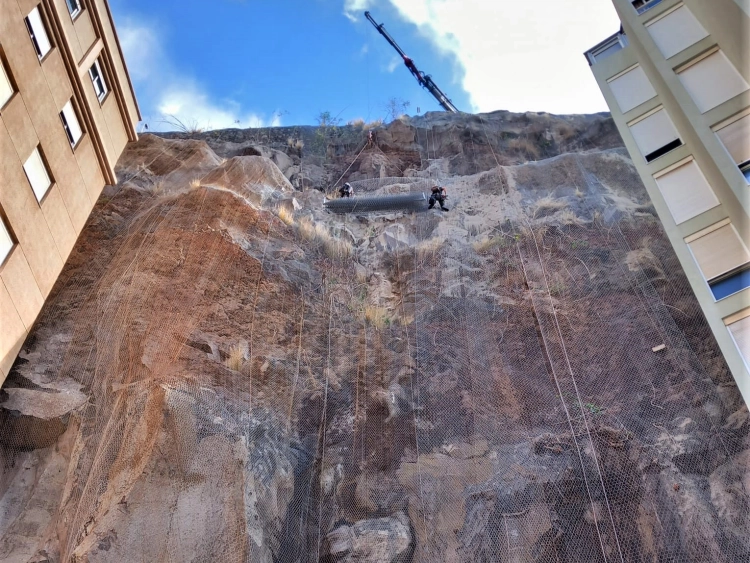
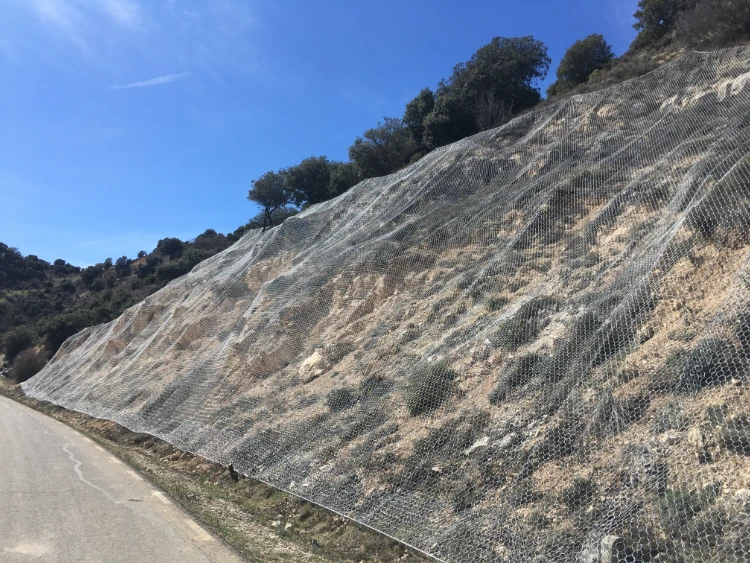
The suspended mesh or mesh with counterweight is a solution that guides the rockfall rather than preventing it. The rocks slide in a controlled manner between the slope and the mesh and end up in the ditch rather than on the road.
Suspended mesh is very suitable when the aim is to prevent small falls of stones of reduced size and weight, and it is the best option where recurrent rockfalls require constant cleaning.
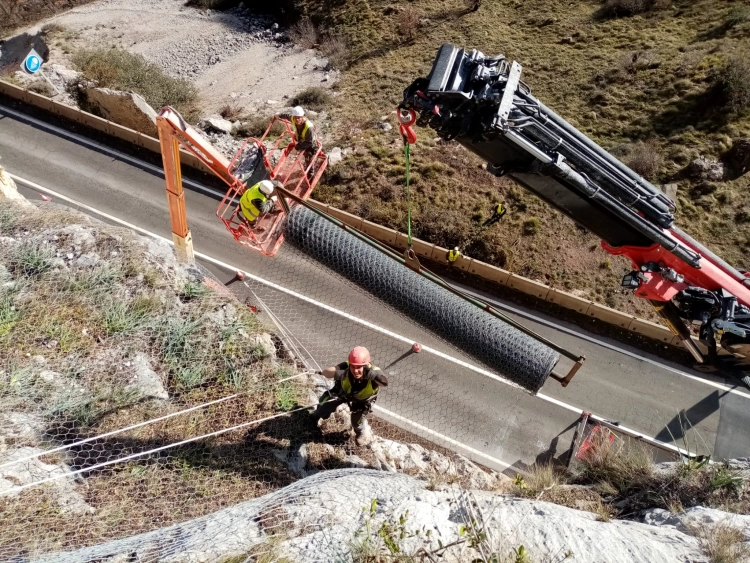
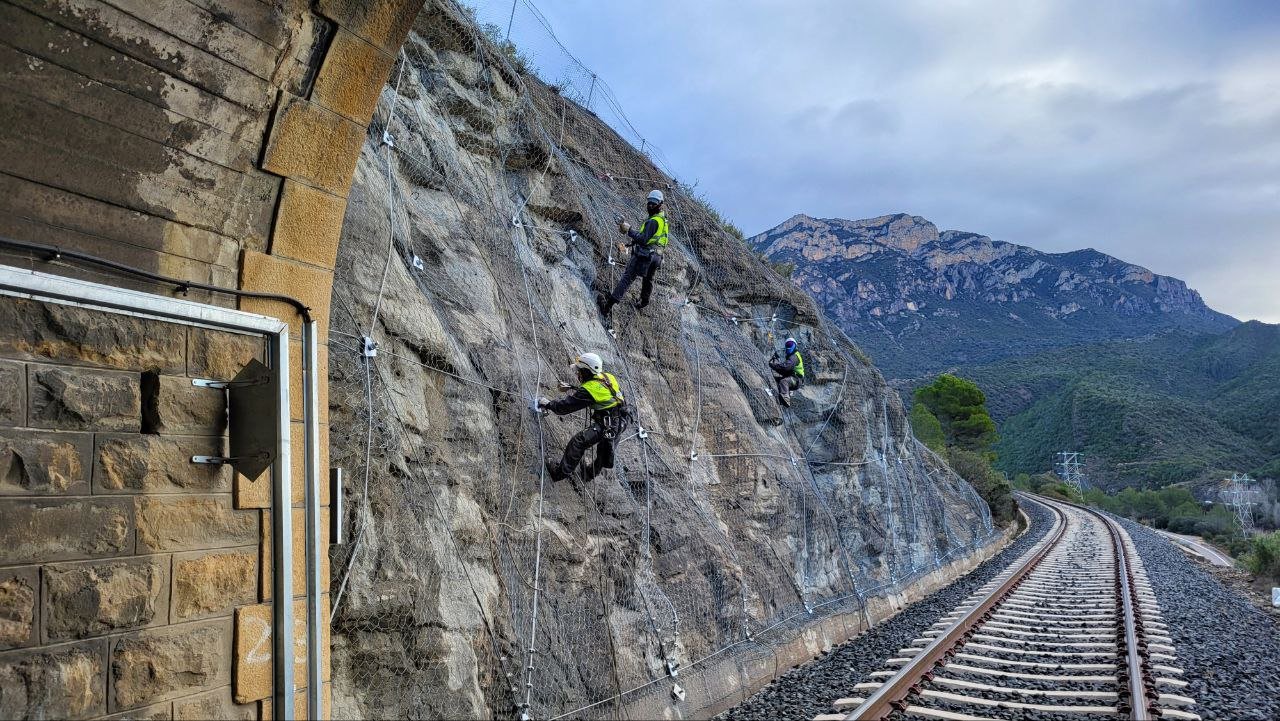
We usually install suspended mesh alongside roads and railway lines. The installation of any type of wire mesh is carried out under strict safety measures and always by teams of operatives specialised in working at height.
Double-twist mesh trap
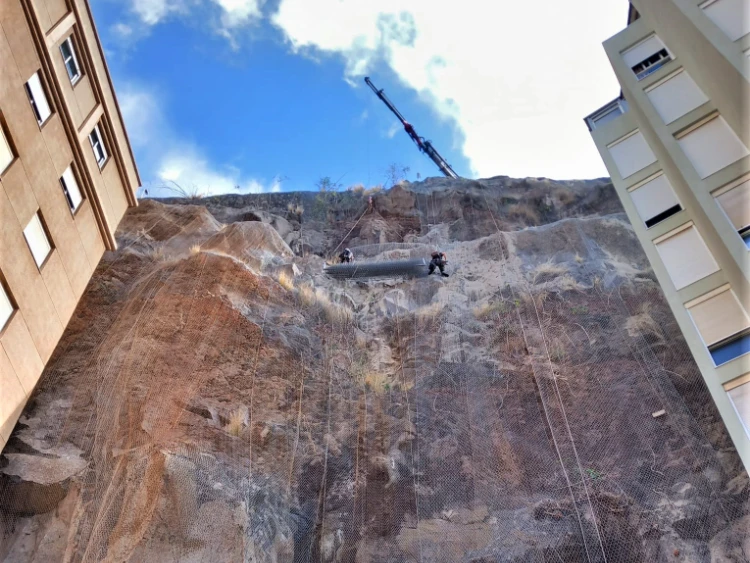
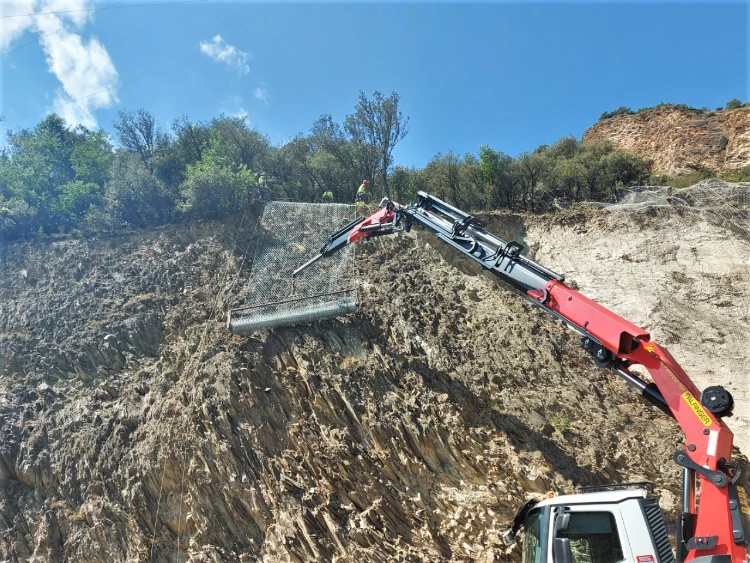
Double-twist mesh traps are designed to control and channel moderate rockfalls from the brow to the base of the slope. Their installation prevents damage to infrastructure caused by stones reaching the carriageway.
The main applications of double-twist mesh traps are:
- Protection against detachments on slopes in mountain areas where there are problems of moderate rock detachments.
- Protection against rockfalls on cut slopes resulting from the construction of railways, conventional roads or motorways, where the aim is to prevent falling rock from affecting the infrastructure.
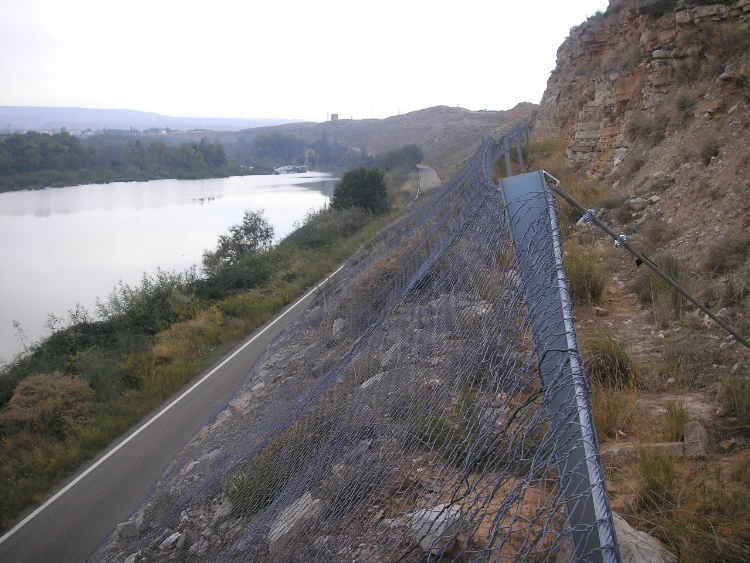
The mesh trap is a variant of conventional suspended mesh, especially suitable in areas where the height of the slope is significant and whose topography allows the rockfalls generated to be intercepted.
By installing elevated stakes or light posts, the mesh curtain is raised with the help of the longitudinal crown cable, which allows any small rock element to be intercepted and its fall to be directed to the foot of the slope.
At Solutioma we advise on, design and install the most suitable mesh trap for each slope.
Reinforced mesh with anchors and cables
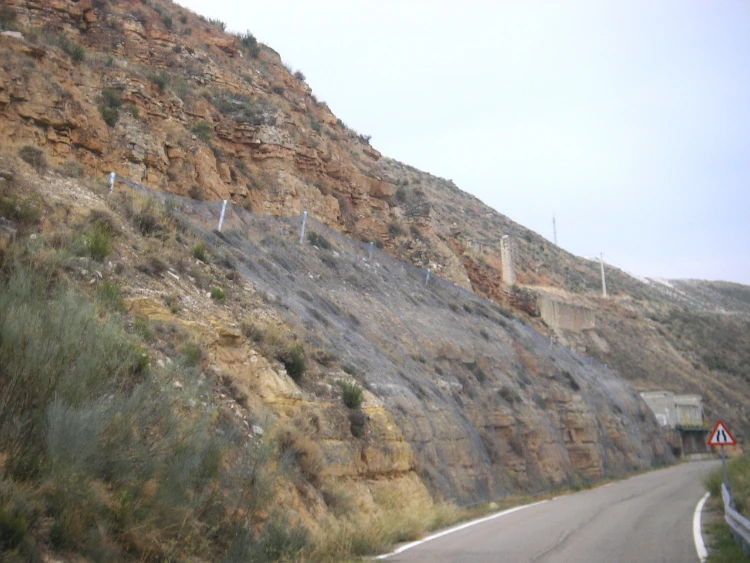
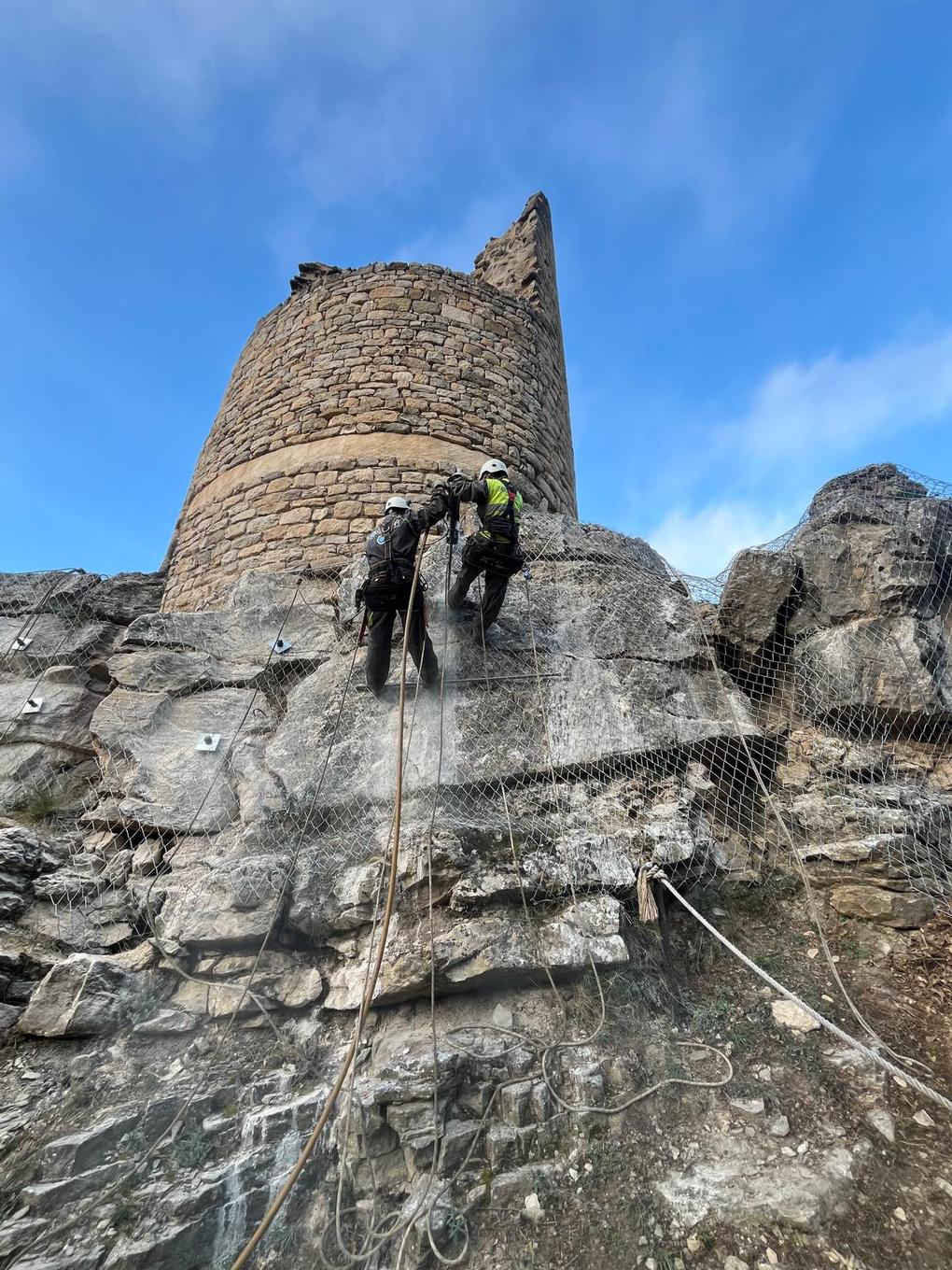
Reinforced mesh systems combine a double-twist mesh placed over the surface of the slope with the installation of anchors and steel reinforcement cables laid in variable orientations: horizontal, vertical or diagonal.
Reinforced mesh is especially suitable in areas where shallow detachments of limited thickness may occur. The cables laid on the surface act on the slope, restraining possible surface movements and transferring the loads received to the anchors.
In each case we size the most suitable anchoring and cabling system so that it adapts to the needs of the terrain within the range of action of the reinforced mesh.
Reinforced mesh is indicated for the stabilisation of slopes with a high risk of falling rocks and blocks, and of cuttings with a high degree of cracking or fracturing caused by human activity, such as mining or civil works. It is also very effective for containing slopes that are unstable due to changes in the strata of the material that make up the cutting profile.
The use of reinforced mesh reduces the need for ditch cleaning along linear infrastructure because, unlike suspended double-twist mesh, this system prevents material from detaching, so it is also suitable where the asset to be protected is located right at the foot of the slope.
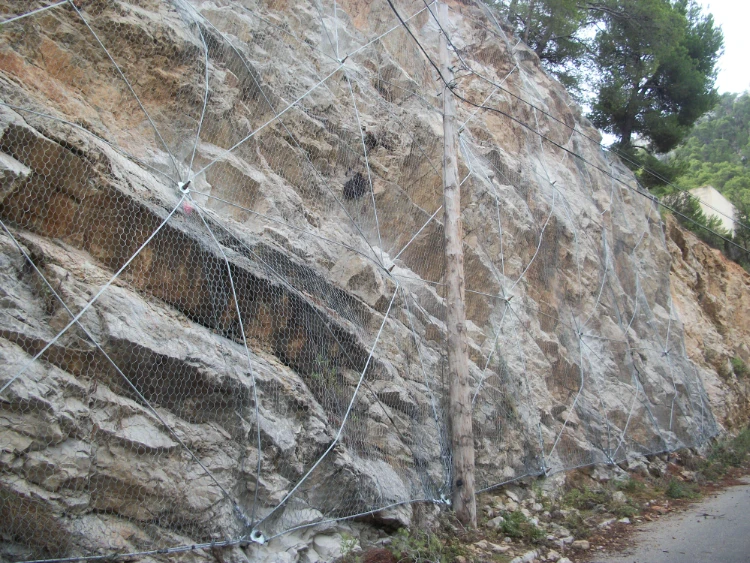
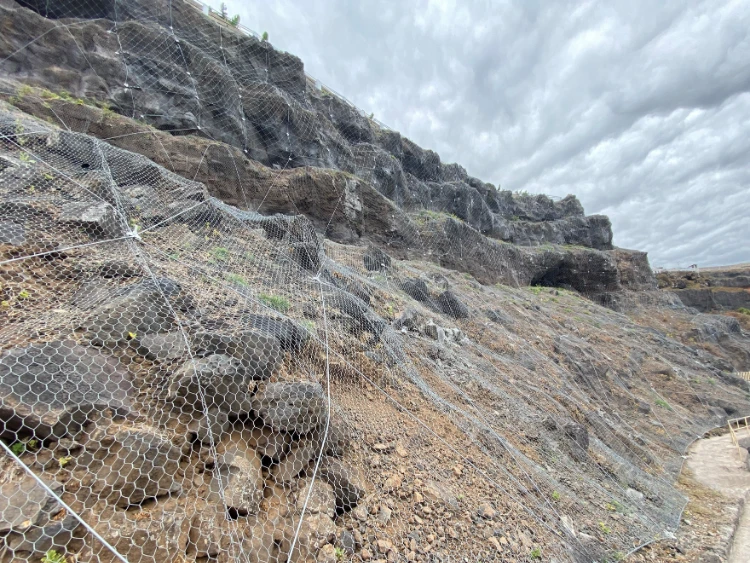
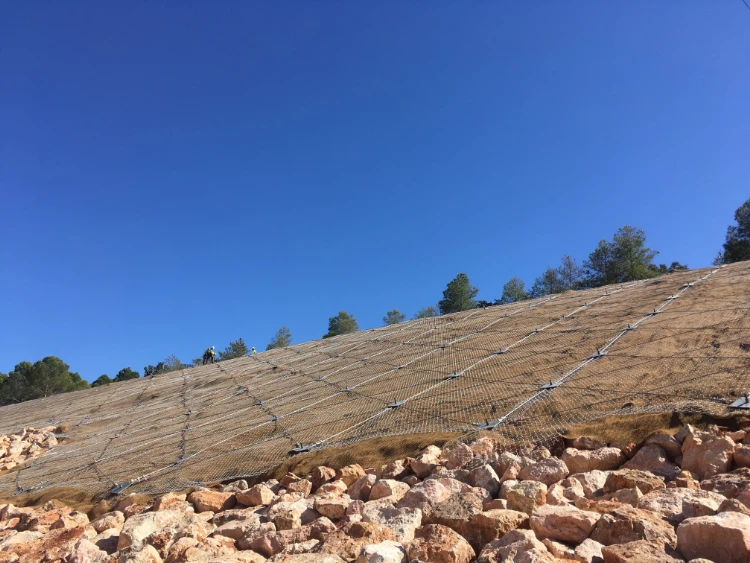
Double-twist mesh installations
Double-twist mesh installations
YouTube channel
Videos of our projects
See how we work on site: slope scaling, dynamic rockfall barriers and rope access work filmed on our projects.
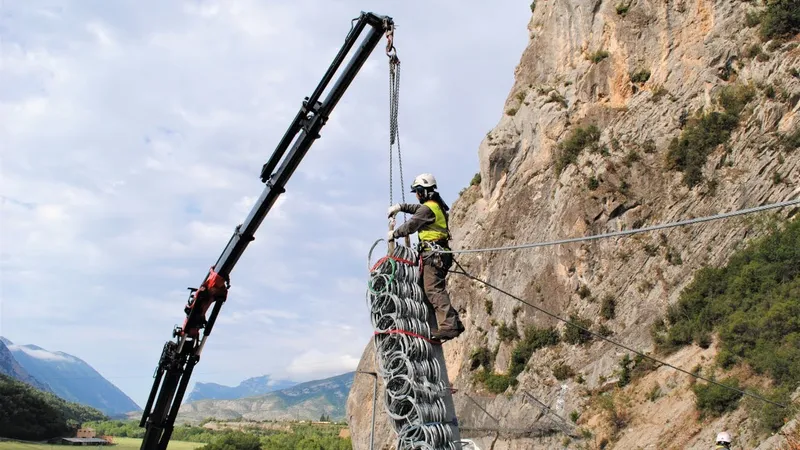
On-site video
Specialists in the installation of double-twist mesh
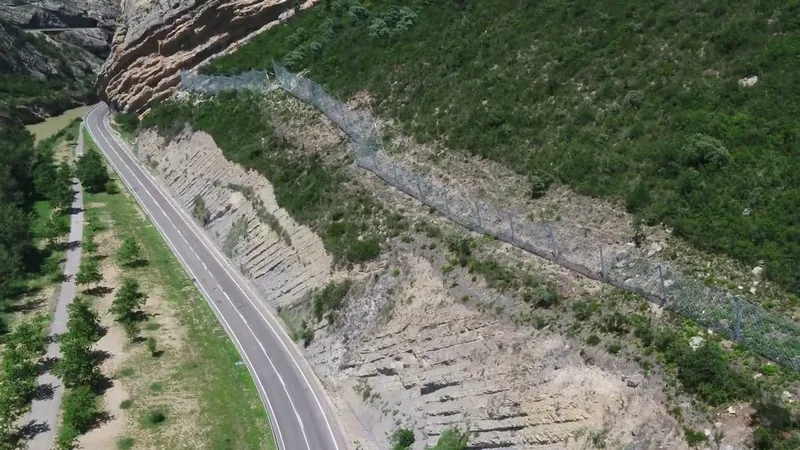
On-site video
Protection against rockfall with dynamic barriers in the Pre-Pyrenees
Frequently asked questions about double-twist mesh
Frequently asked questions about double-twist mesh
What is double-twist mesh?
Double-twist mesh is a hexagonal lattice of galvanised steel wires that is spread over a slope to retain or guide small rockfalls. It is also known as double twisted wire mesh, DT mesh, twist mesh or hexagonal wire mesh.
The name comes from the way the mesh is manufactured: each pair of adjacent wires is twisted together through three half-turns at every joint, and this forms the hexagonal cell. The twisted joint gives the mesh the flexibility to adapt to irregularities in the ground and prevents it from unravelling easily if a wire breaks.
The mesh retains blocks larger than its opening and protects the surrounding area from their reach. Depending on how it is installed, it works as suspended mesh, also called rockfall drapery mesh, which guides stones down to the ditch; as a mesh trap, which intercepts rockfalls from the brow; or as reinforced mesh with anchors and cables, which holds the material on the slope itself.
At Solutioma we install all three variants with teams specialised in working at height. If stones are falling from your slope, tell us what is happening and we will advise you on the type of mesh it needs.
When is double-twist mesh used on slopes?
Double twist mesh for slopes is used when a slope repeatedly sheds small stones or blocks and these must be kept away from a road, a railway or other infrastructure. It is one of the most common types of rockfall netting on cuttings and hillsides.
The variant depends on the problem. Suspended mesh is the best option for recurrent falls of small, light stones, because it deposits them in the ditch, where cleaning is simple. The mesh trap is reserved for high slopes with moderate rockfalls, which is why it is a common rockfall mesh in mountain areas and on railway and motorway cuttings.
Reinforced mesh is indicated when the risk of falling rocks and blocks is high, on cuttings heavily fractured by mining or civil works, or when the asset to be protected lies right at the foot of the slope. In all cases, double-twist mesh does not stop the erosion of fines on its own: if the slope is losing soil, it is combined with erosion control systems.
Our technicians inspect the slope, identify the type of rockfall and propose the appropriate variant, or a different solution if mesh alone is not enough.
How is double-twist mesh installed on a slope?
Double-twist mesh is installed by anchoring it at the head of the slope, laying it over the surface and weighting it at the base with a counterweight, so that it stays as close to the ground as possible.
According to our technical data sheets, the process begins with manual scaling of the slope head, removing loose stones and cutting back vegetation. Next, the stakes or upper anchors are placed, set back 1 to 2.5 m from the edge of the slope; the mesh is rolled out and the upper anchorage is completed with galvanised cable and stakes or small anchors. The strips of mesh are stitched together and, finally, the bottom counterweight, a 45 mm galvanised tube, is fitted.
In anchored mesh, intermediate anchors are added as the ground requires, so that the mesh fits tightly against the slope. In a mesh trap, the curtain is raised with elevated stakes or light posts and a longitudinal crown cable. In reinforced mesh, bores and anchors are executed and a grid of steel cables is tensioned in a square or staggered pattern.
At Solutioma we carry out the installation with teams specialised in working at height and our own machinery; when the slope has no access track, the material arrives by truck-mounted crane or helicopter. Before starting, we explain the planned procedure for your project.
Reinforced mesh or high-resistance membrane: which is better?
Reinforced mesh is the better choice when rockfalls are shallow and of limited thickness; if large blocks or unstable masses must be secured, a high-resistance membrane is usually more suitable.
Both solutions start from a double-twist mesh fixed with anchors, but they work differently. In reinforced mesh, the steel cables are laid over the mesh once it is in place, horizontally, vertically or diagonally, and restrain surface movements by transferring the loads to the anchors. In a high-resistance membrane, the steel cable is woven into the mesh during manufacture, which gives it greater resistance.
The decision depends on the size of the blocks, the degree of fracturing of the rock mass, the thickness of the unstable material and the loads that the system must transfer to the ground. Reinforced mesh also allows rock slopes with soil at the base to be revegetated with climbing plants, which is why it is widely used on urban slopes and in areas of landscape value.
At Solutioma we design both alternatives and recommend the one that best suits your slope. If you already have a geotechnical study, we will review it with you.
Which galvanised double twist mesh is used on slopes?
On slopes, galvanised double twist mesh is used with a mesh type and wire diameter that depend on the variant: generally type 8x10 for suspended and anchored mesh, and preferably type 5x7 for mesh traps.
Our technical data sheets specify type 8x10/15 with 2.4 mm galvanised wire for suspended mesh, which may also be 2.7 or 2 mm. For anchored mesh they indicate type 8x10/16 with 2.7 mm wire, also available in 2 and 2.4 mm. For mesh traps, type 5x7-13 is preferred, with a 50 x 70 mm opening and 2 mm wire, because its mesh opening prevents detached rock fragments from passing through.
Galvanising protects the steel against corrosion, and the mesh opening is chosen according to the size of the stones to be retained, since the mesh only holds blocks larger than its aperture. When the rock breaks into very small pieces or the slope loses fines, the mesh is complemented with other systems.
The final type is set in the design of each slope. If you need a precise specification for a tender or for contract documents, our technical department will help you define it.
How much does double-twist mesh for slope protection cost?
The price of double-twist mesh for slope protection is not set per square metre in general terms: it depends on the area, the variant that the slope requires and, above all, the access conditions.
The factors that weigh most are the mesh and wire type, the number and length of the anchors, prior scaling of the slope head and, in reinforced mesh, the anchors and reinforcement cables. Suspended mesh on a road cutting and a mesh trap on a high hillside have very different costs, even if they cover the same area.
Access usually makes the difference: working from the carriageway is not the same as working suspended on ropes or with helicopter support to lift the material. Subsequent maintenance also counts: suspended mesh makes ditch cleaning easy, and reinforced mesh, according to our data sheet, offers high levels of safety with minimal maintenance costs afterwards.
To prepare an assessment, send us the location, some photographs and the approximate area of the slope. We work in Spain and internationally, and you can also call us on +34 900 101 895.
Contact
Why entrust your double-twist mesh to Solutioma?
At Solutioma we study, design and install double-twist mesh to protect roads, railways and infrastructure against rockfalls, with people who have more than 30 years of experience in the sector, teams specialised in working at height and our own machinery.
If you would like to discuss any questions with our technical team or request a quote for double-twist mesh installation, please fill in the form below. If you prefer, you can also call us on +34 900 101 895; we will be happy to assist you.
- +34 900 101 895
Call us if you prefer - solutioma@solutioma.com
Write to us directly - Over 30 years of experience
Survey, design and execution with our own team and machinery - Offices in Spain and Romania
Lleida, Madrid, Canary Islands, Jaén, Gipuzkoa and Bucharest