
The risk of avalanches in mountain areas and critical infrastructure
High mountain areas present a recurring natural risk associated with snow avalanches, phenomena that can reach high speeds and exert considerable impact forces on infrastructure, buildings, and people.
The combination of steep slopes, snow accumulation, and thermal variations creates favorable conditions for the sliding of large masses, which in a matter of seconds can affect roads, railway lines, ski resorts, or energy facilities.
In Spain, exposure to this type of risk is especially concentrated in the Pyrenees, the Cantabrian Mountains, and Sierra Nevada, where weather conditions and orography increase the possibilities of snow avalanches.
In these environments, the protection of critical infrastructure—mountain roads, power lines, isolated buildings, or tunnels—is essential to ensure safety and continuity of services.
Table of contents
The use of avalanche barriers has become established as one of the most effective solutions for preventing the effects of avalanches. These structures are installed in the area of origin of the slide, intercepting the mass of snow before it acquires speed and destructive energy.
The modern approach to avalanche risk management combines geotechnical analysis, terrain modeling, and the implementation of adaptive protection systems, capable of integrating into the environment and minimizing environmental impact. This type of solution not only provides security but also reinforces the resilience of infrastructure against the effects of climate change and the increased frequency of extreme events.
Dynamic avalanche barriers: design, operation, and advantages
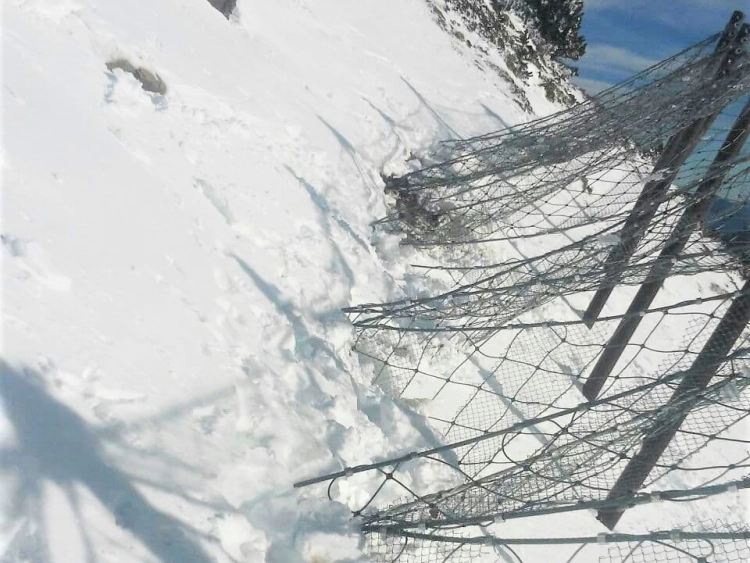
Technological development and accumulated experience in mountain engineering have driven the use of dynamic avalanche barriers, capable of absorbing the kinetic energy of avalanches without collapsing or requiring excessively rigid structures. These solutions are based on flexible steel cable net systems anchored to the ground by posts and slings, designed to adapt to the deformation produced by the impact and dissipate energy in a controlled manner.
The flexible barriers allow for lighter installation, reduced maintenance, and superior landscape integration compared to other solutions. In addition, the possibility of modulating their height, resistance, and separation between sections facilitates their adaptation to the specific conditions of each slope or avalanche corridor.
This evolution is complemented by the incorporation of monitoring and early warning technologies, which use sensors, telemetry, and digital modeling to detect snow movements and assess the behavior of the barriers in real time. This integrated approach optimizes design, improves emergency response, and extends the lifespan of the facilities.
They are safe, sustainable, and efficient systems that combine advanced structural engineering with predictive analysis and intelligent risk management. The dynamic avalanche barriers represent today a consolidated and highly reliable solution for the protection of critical infrastructure in high mountains.
Some examples of this type of project, carried out by our team
Related articles:
Flexible barriers and energy dissipation
The flexible avalanche barriers are composed of high-strength steel cable nets, tubular posts, and a set of anchors and slings that allow the energy generated by the impact of moving snow to be absorbed progressively. Its operation is based on the controlled deformation of the system, which acts as a shock absorber, reducing the load transmitted to the ground and preventing structural failure.
Unlike rigid systems, these solutions offer greater adaptability to different topographic configurations and allow covering large surfaces without significantly altering the morphology of the terrain. In addition, its modular design facilitates transport and assembly in areas of difficult access, optimizing execution times and reducing maintenance costs.
These energy dissipation barriers are normally installed in the area of origin of the avalanche or in the accumulation corridors, where the kinetic energy of the snow mass is greater.
Its effectiveness has been widely proven in protection projects for roads, railway lines, and ski resorts, establishing itself as a reliable, versatile, and high-performance technical solution.
Monitoring and early warning technologies
The incorporation of digital technologies in avalanche protection systems has brought about a paradigm shift in risk management. The dynamic avalanche barriers can be integrated with deformation sensors, inclinometers, weather stations, and thermal cameras that monitor snow, temperature, and wind conditions in real time.
These remote monitoring systems allow detecting the formation of unstable slabs, measuring the stresses accumulated in the structural elements, and anticipating the possible triggering of an avalanche. The data collected is transmitted to control centers through secure communication networks, where it is processed to generate early warnings and predictive models.
The result is a much more proactive risk management, which combines civil engineering with data intelligence. In this way, decisions on maintenance, evacuation, or preventive closure of infrastructure can be made based on objective and updated information. The integration of these technologies reinforces the efficiency, safety, and sustainability of projects in high mountain areas, aligning with the most advanced European standards in protection and prevention.
Factors of choice and application in real projects
The selection of the most appropriate protection system against avalanches depends on a series of geotechnical, climatic, economic, and environmental variables. Each site presents specific conditions that determine both the intensity and frequency of the risk as well as the type of technical solution that should be applied.
Optimal design requires a comprehensive study that combines field analysis, terrain modeling, and dynamic scenario simulation, thus ensuring the effectiveness and durability of the installation.

Geographic and climatic conditions
The avalanche barriers are designed based on factors such as the orientation of the slope, the gradient, the altitude, the exposure to the wind, and the average annual amount of solid precipitation. In high mountain areas, where snowfall is intense and persistent, flexible retention systems capable of withstanding large dynamic loads are prioritized.
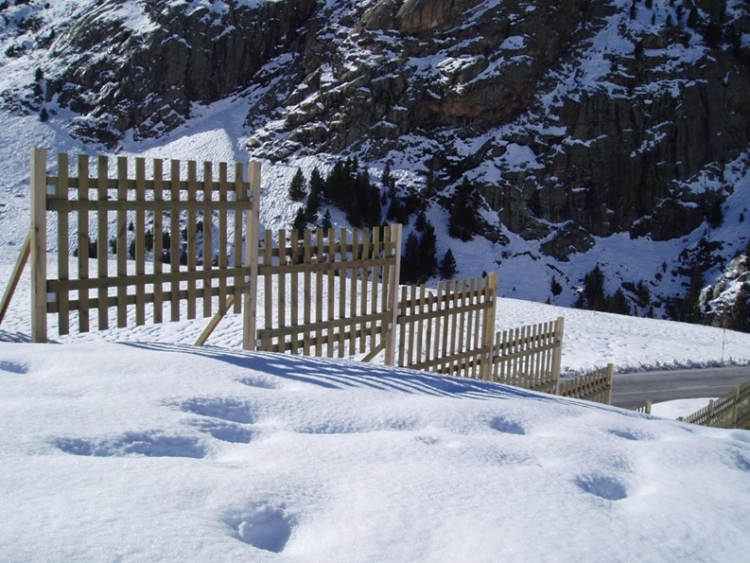
On the other hand, snowdrift barriers are applied in very different contexts: areas with gentle or flat slopes where the wind transports the snow and accumulates it on roads or railways. These screens, usually made of treated wood or galvanized steel, reduce the speed of the wind and control the accumulation on the infrastructure, improving road safety and winter operability, but they are not designed to stop avalanches or resist dynamic impacts.
The correct adaptation of the system to the local characteristics guarantees its operation, and also reduces the environmental impacts, improving the landscape integration.
Costs and sustainability of innovative solutions
Advances in materials and structural design have made it possible to develop dynamic avalanche barriers with a better relationship between cost, durability, and performance. These structures, made of galvanized steel cable, offer a long service life and minimal maintenance, which significantly reduces long-term operating costs.
Overall, the choice of a protection system should not only address safety and functionality but also its technical and economic sustainability within the project lifecycle. At Solutioma, we have a team specialized in defining the solution and installing protection systems against landslides and avalanches. Contact us for personalized technical advice and to study the best solution for your project.