
Slope stabilisation
Green walls
Green retaining walls for slopes: earth retention with a vegetated face, no height limitations and an alternative to reinforced concrete.
- Over 30 years of experience
- Survey, design and execution with our own team and machinery
- Offices in Spain and Romania
Green retaining walls for slope stabilisation
A green retaining wall, or eco retaining wall, is an earth-retaining wall with a vegetated front face that stabilises the slope and blends it into the landscape. At Solutioma, we design and build it as a slope stabilisation alternative with maximum integration into the environment.
In slope stabilisation, green walls usually act as retaining or gravity walls. Thanks to their planted finish, green walls are particularly suitable for residential areas or places of public interest.
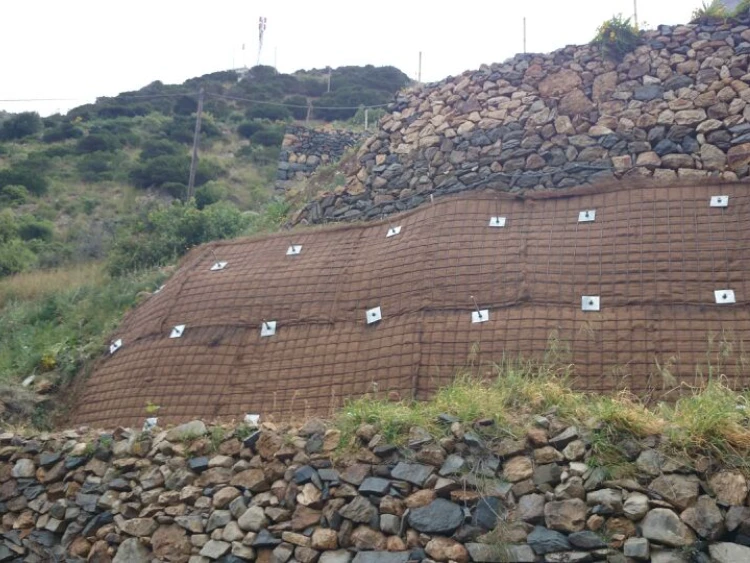
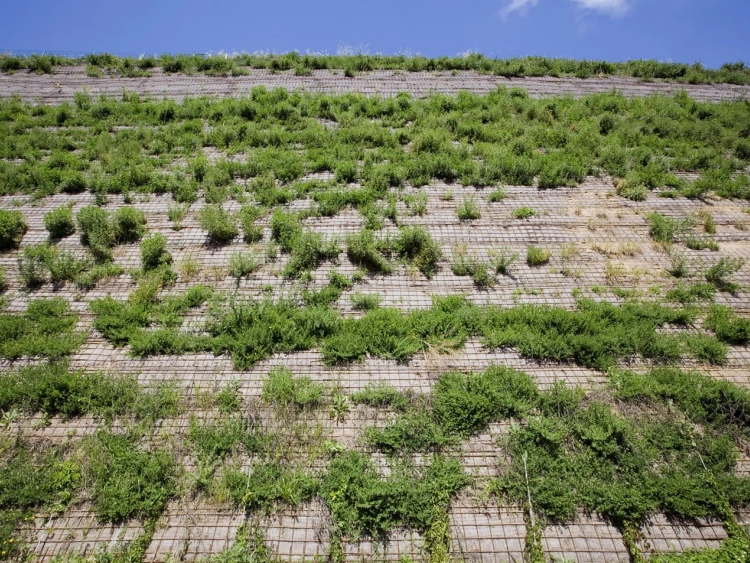
Do you need to retain a slope without spoiling the landscape?
We study the ground and propose the right green retaining wall for you. You can also call us on +34 900 101 895.
What are green walls like?
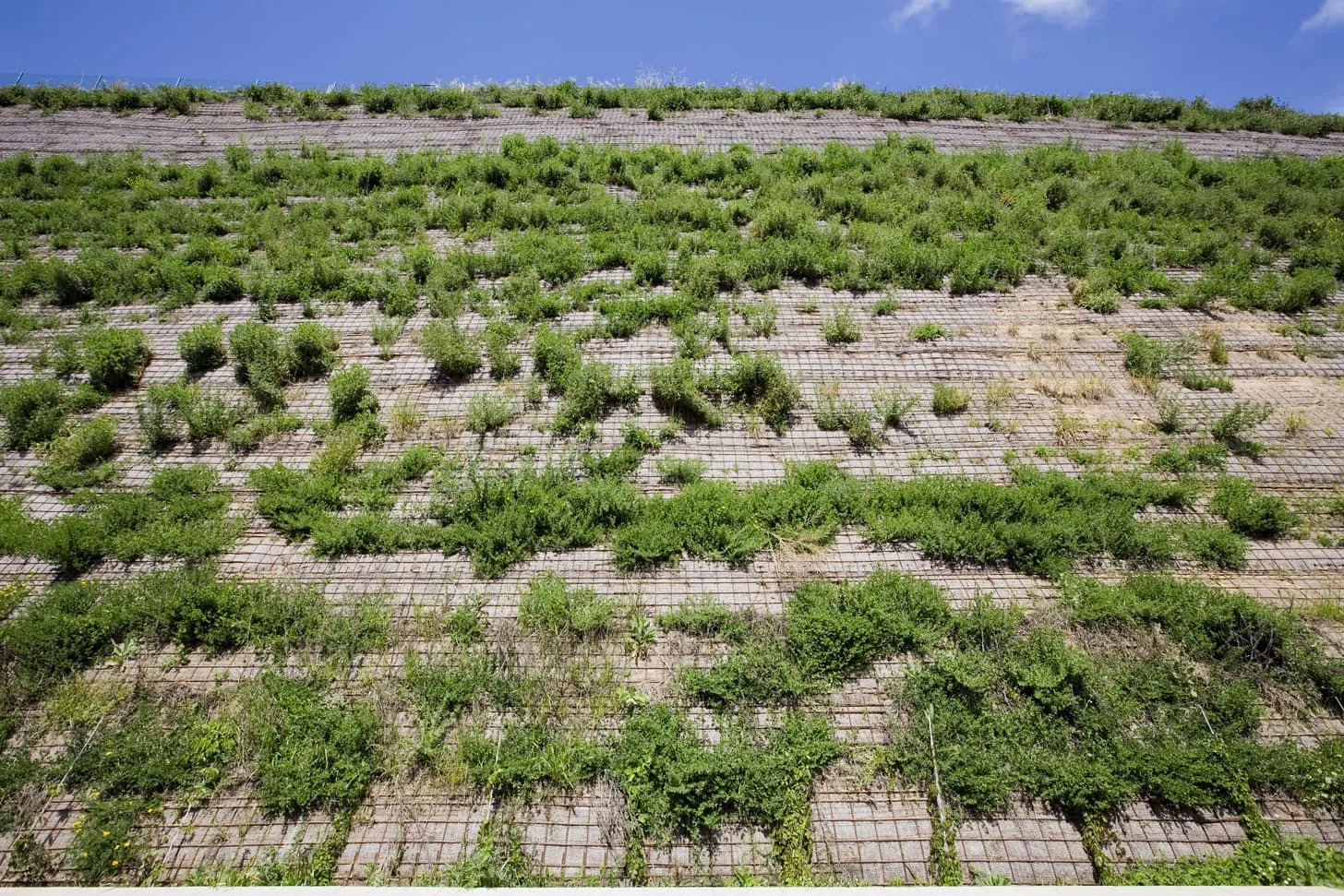
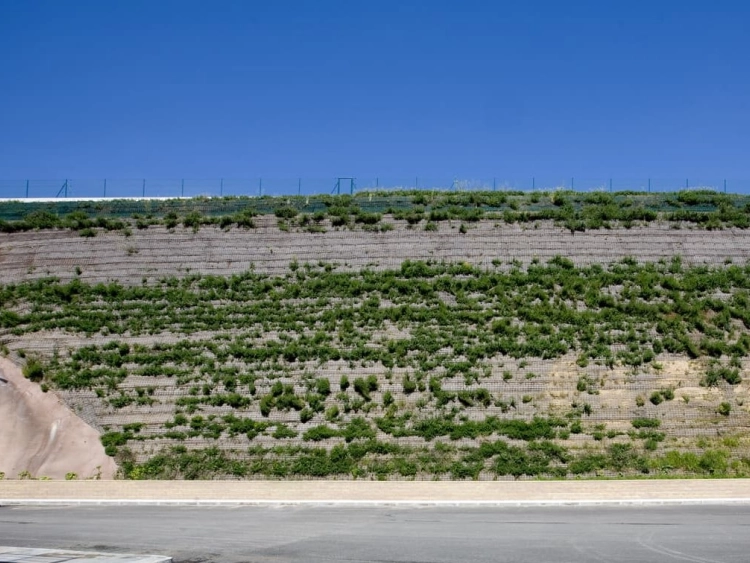
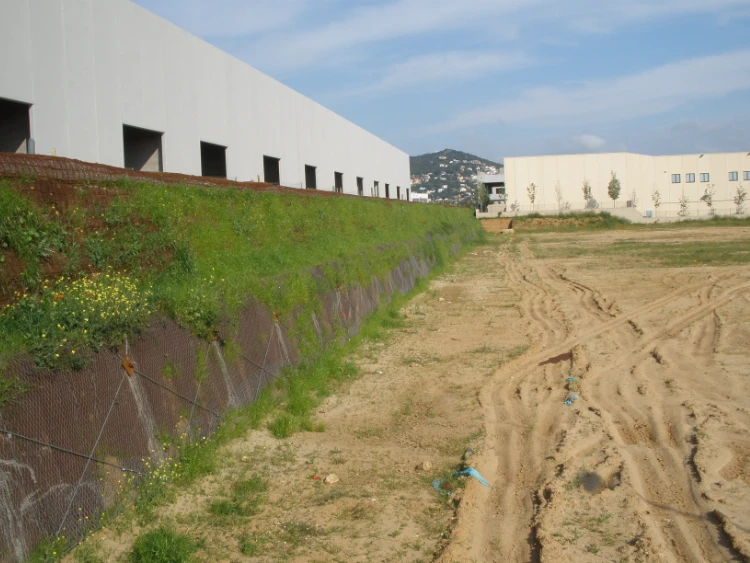
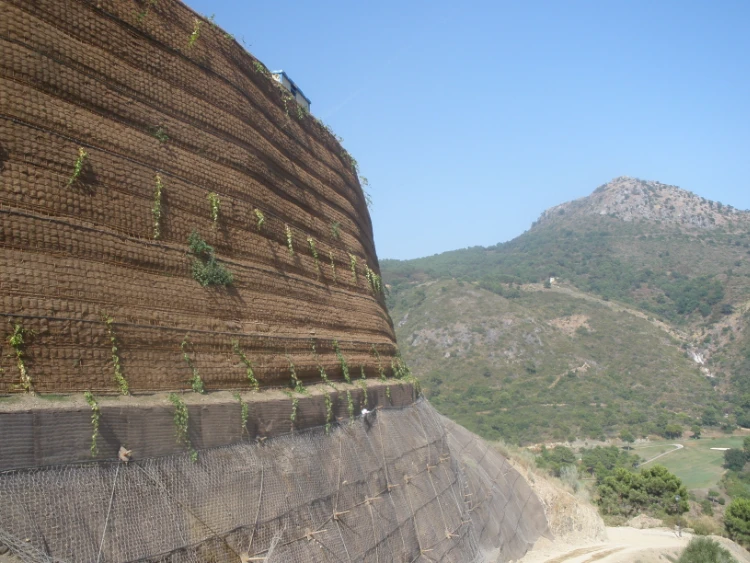
The green wall is a system that extends bioengineering techniques to the construction of retaining walls, with no height limitations and maximum landscape integration thanks to the plant cover that develops over its entire surface.
Green walls are particularly suitable as substitutes for reinforced concrete retaining walls, as they are more economical and their landscape impact is undoubtedly lower. They also replace rock armour, masonry and gabions when rock is scarce. They can be used in all types of works with embankment slopes of up to 80°.
Components of a green wall
Features of green walls
The green wall is composed of the following elements:
- High-strength welded mesh, acting as permanent formwork.
- Reinforcement geogrid or, in the green anchored wall, ground anchors.
- Geotextile blanket made of coconut and polypropylene fibres.
- Fill material that is added as the wall is built.
Green walls adapted to each project
At Solutioma, we adapt each green wall to the stabilisation needs and the characteristics of the ground, so that the installation is effective and safe.
Study and installation of green walls
To design the wall, we first carry out a thorough ground study and the corresponding calculations, since the type and length of the geogrid depend on the characteristics of the ground, the angle of inclination and the surcharge that the wall will have to bear.
In the final design, we also consider possible water seepage and, in these cases, we install drainage systems. The green wall allows herbaceous, shrub and climbing species to be planted.
Green walls we have built
Green walls we have built
Frequently asked questions about green walls
Frequently asked questions about green walls
What is a green retaining wall?
A green retaining wall, also called an eco retaining wall or vegetated retaining wall, is an earth-retaining wall whose front face is fully vegetated and integrated into the landscape.
Instead of building a concrete face, it is constructed with high-strength welded mesh at the front, a reinforcement geogrid or anchors that connect it to the ground, a geotextile blanket of coconut and polypropylene fibres and fill material placed in layers as the wall rises. The blanket acts as a bed for the vegetation and retains the substrate.
Green walls extend bioengineering techniques to retaining walls: the structure holds back the soil and, at the same time, becomes covered with plants over its whole surface. That is why they are particularly suitable for residential areas or places of public interest, where the visual impact of a reinforced concrete wall would be hard to accept.
At Solutioma, we study the ground, calculate the wall and build it on site. If you are looking for a way of retaining a slope that blends better into its surroundings, we will be happy to assess your case.
What type of retaining wall can be built on a slope?
Several types of wall can be built on a slope, mainly green walls, gabion walls or reinforced concrete walls; the choice depends on the height, the inclination, the presence of water and the finish that the setting requires.
A green wall on a slope is suitable when landscape integration is a priority, and it is used on embankment slopes with inclinations of up to 80°. It replaces reinforced concrete walls with a much lower visual impact and at a lower cost, and it also replaces rock armour, masonry and gabions when rock is scarce.
A gabion wall offers a stone finish and lets water pass through its structure, which makes it attractive on slopes with seepage. Reinforced concrete is usually reserved for cases with very little space, at the cost of a greater landscape impact than a vegetated retaining wall.
Before choosing a retaining wall for a slope, it is important to know the ground, the surcharge it will bear and whether water is present. Our technical department studies each slope and proposes the solution that best balances stability, integration into the surroundings and construction conditions.
How is a green anchored wall built?
A green anchored wall is built by raising a face of welded mesh that is connected to the ground with bar anchors or rock bolts, while the fill is placed in layers. It is the ideal solution when soil has to be replaced and there is no room for other conventional systems.
The high-strength welded mesh is placed at the front as permanent formwork and makes it possible to adjust the slope of the wall. Behind it, the fill is placed in successive layers, and the rock bolts or bar anchors tie the face to the natural ground, so that the structure takes up little space behind the face.
The geotextile blanket of coconut and polypropylene fibres is placed on the front face, where it acts as a bed for the vegetation and holds the topsoil in place. If there is seepage, drainage systems are installed before the fill is completed.
The type and length of the anchors are defined after the ground study and the corresponding calculations. At Solutioma, we carry out both phases and the construction with our own machinery; tell us about the conditions of your slope and we will propose the most suitable variant.
What is the difference between a green retaining wall and a geomat?
A green retaining wall is a retaining structure that holds back soil, whereas a geomat is an erosion control covering that protects the surface of a slope while vegetation takes root, without resisting ground pressure.
The difference lies in the problem each one solves. A green wall is built when a change in level has to be retained or soil has to be replaced and the face is required to be vegetated; technically, it is a reinforced soil structure, similar to a reinforced soil slope with a steeper face. A geomat, on the other hand, is laid over a slope that is already stable to retain fines and prevent washout by rain and wind.
The choice therefore depends on whether the slope needs retention or only surface protection. A slope at risk of sliding, or without room to regrade it, requires a wall; a stable but erodible slope can be treated with a three-dimensional geomat and seeding.
At Solutioma, we work in both areas, slope stabilisation and erosion control, and we study the slope before proposing one or the other. Send us a few photographs and we will tell you which option fits your case.
What plants can be used on a green wall?
Herbaceous, shrub and climbing species can be planted on a green wall, rooting in the geotextile blanket of coconut and polypropylene fibres placed on the front face.
The blanket acts as a bed for the vegetation and holds the substrate, so that the roots find support while the cover develops. Over time, the vegetation covers the whole surface and the planted retaining wall is perceived as just another green slope in the landscape.
The choice of species depends on the local climate and on the inclination and orientation of the wall. In many cases, it is highly advisable to install a pressure-compensated drip irrigation system in the final phase of the works, which helps to keep the plant cover in good condition and turns the structure into a true living retaining wall.
At Solutioma, we apply to green walls the same experience that we bring to substrate spraying and slope revegetation. If you tell us where the wall is located, we will advise you on the vegetation and irrigation best suited to it.
How much does a green retaining wall cost?
The cost of a green retaining wall depends on its height and inclination, the type and length of geogrid or anchors resulting from the calculations and the site conditions, so it is studied case by case.
In addition to the structure, the volume of fill to be supplied, the need for drainage if there is seepage, the installation of drip irrigation, the chosen vegetation and machinery access to the slope all play a part. The surcharge that the wall will have to bear, for example a road or a building at the crest, also affects its design.
As a guide, our technical data sheet states that green walls are more economical than reinforced concrete walls for earth retention, as well as having an undoubtedly lower landscape impact.
To receive an assessment, send us the location, a few photographs and the approximate dimensions of the slope; if you have a geotechnical report, it will help us to refine the proposal. We work in Spain and internationally, and you can reach us on +34 900 101 895.
Contact
Why entrust your green wall to Solutioma?
At Solutioma, we study, design and build green walls to retain slopes and blend them into the landscape, with people who have more than 30 years of experience in the sector, rope access teams and our own machinery. If you would like to discuss any questions with our technical team or request a quote for your green wall, please fill in the form below. If you prefer, you can also call us on +34 900 101 895; we will be happy to assist you.
- +34 900 101 895
Call us if you prefer - solutioma@solutioma.com
Write to us directly - Over 30 years of experience
Survey, design and execution with our own team and machinery - Offices in Spain and Romania
Lleida, Madrid, Canary Islands, Jaén, Gipuzkoa and Bucharest