
Slope stabilisation
Soil Nailing
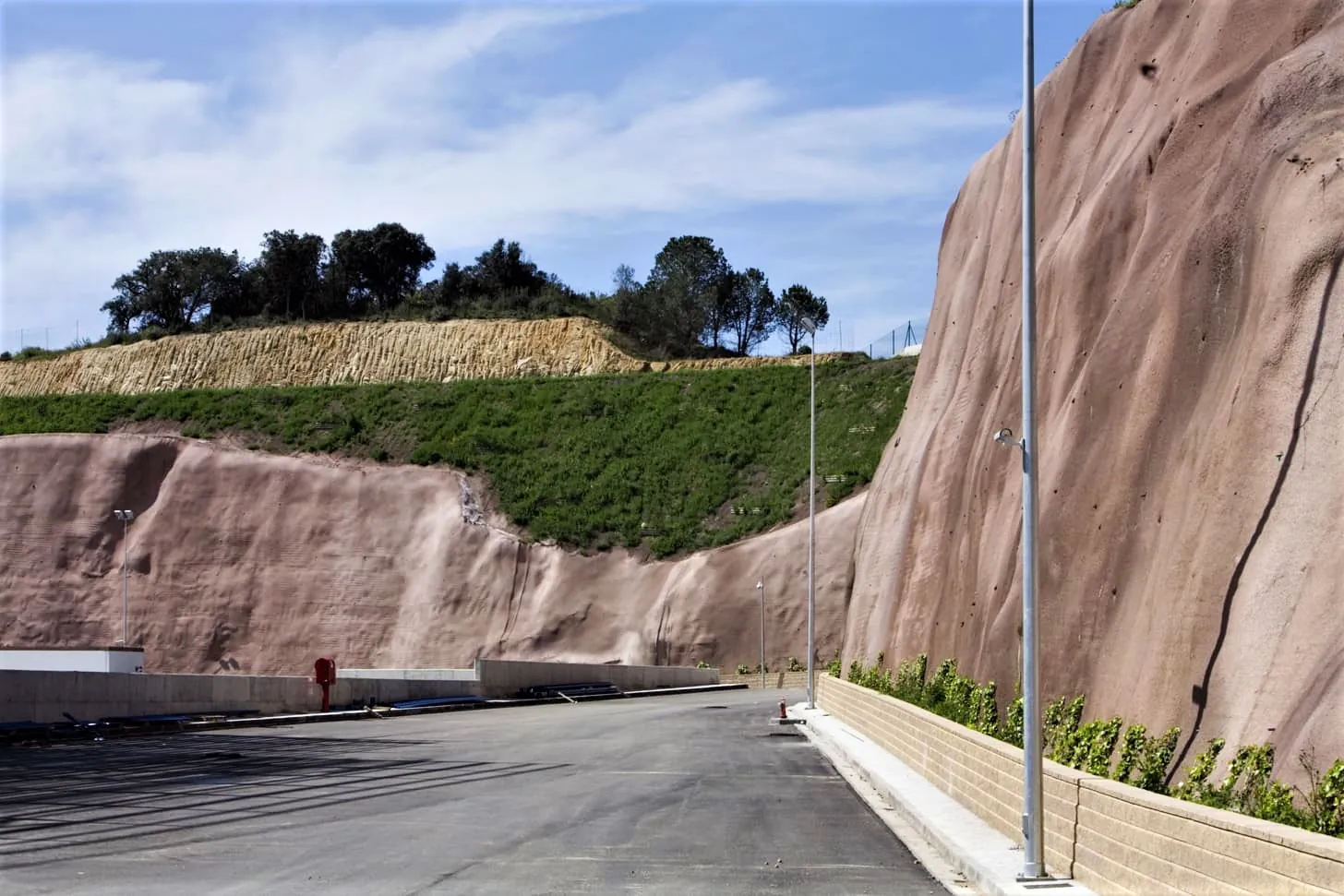
Soil Nailing and soil nail walls: anchors, welded mesh and sprayed concrete to support excavated slopes. In-house design and installation.
- Over 30 years of experience
- Survey, design and execution with our own team and machinery
- Offices in Spain and Romania
Soil Nailing for the stabilisation of excavated slopes
Soil Nailing is a reinforcement system that supports excavated slopes as the excavation of the ground progresses. At Solutioma, we study, design and carry out Soil Nailing solutions with our own specialised machinery for slope stabilisation in building and civil engineering works.
The Soil Nailing system consists of installing closely spaced reinforcing anchors which, combined with welded steel mesh and a layer of sprayed concrete or shotcrete, keep the slope stable during excavation.
Do you have an excavation that needs to be supported?
We study the ground and propose the right Soil Nailing solution for you. You can also call us on +34 900 101 895.
What is Soil Nailing?
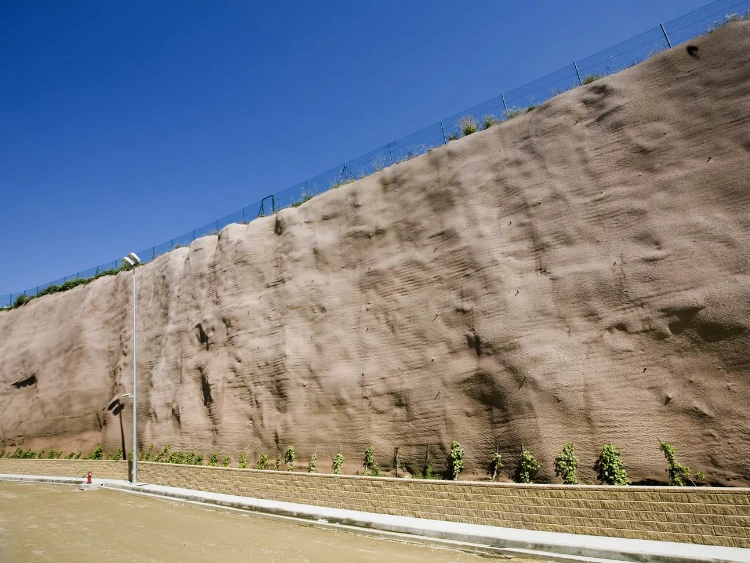
Soil Nailing, or ground nailing, is a ground reinforcement technique that consolidates the slope through an integrated solution made up of anchors (soil nails), welded mesh and sprayed concrete.
Soil Nailing is commonly used in large excavations resulting from major earthworks, where cut slopes of considerable height are created.
Advantages of Soil Nailing
Soil Nailing offers multiple benefits:
- Efficiency and flexibility: it adapts to a wide range of soil types and geological conditions.
- Reduced environmental impact: minimal alteration of the landscape and natural surroundings.
- Speed of execution: short construction times and high output, suitable for projects with tight deadlines.
Soil Nailing construction process
Evaluation and design
At Solutioma, we adapt each Soil Nailing system to the specifications of the ground, following a thorough site evaluation by our ground analysis specialists. The characterisation of the anchors, the definition of the welded mesh and the composition of the shotcrete depend on the characteristics of each slope.
Installation of the anchors
Soil Nailing starts with the installation of the anchors, which work mainly in tension, and proceeds from the crest to the toe as the excavation advances. Once the high-strength steel bars, usually GEWI-type or self-drilling, have been inserted and grouted, one or more layers of welded mesh are installed and the anchors are secured with their bearing plates and nuts.
Application of sprayed concrete
Sprayed concrete or shotcrete is then applied over the surface of the slope, in as many layers as necessary to cover the mesh and the anchor heads, thus completing the reinforcement.
The characteristics of the bolts, reinforcement, and sprayed concrete will always depend on the reinforcement needs of the terrain.
Applications of Soil Nailing
- In building: it is used to reinforce excavated slopes, basements, car parks, etc.
- In civil engineering: this technique is used for the stabilisation and reinforcement of cut slopes in roads, superstructures, tunnels, etc.
Soil Nailing not only provides stability to the slope, but also allows safe working conditions for operatives on site at the foot of the slope.
Solutioma’s commitment to Soil Nailing
At Solutioma, we build the soil nail wall from start to finish, from the anchors to the spraying of the concrete, with our own specialised machinery.
Our technical department studies, designs, sizes and plans each Soil Nailing solution according to the geotechnical properties of the area.
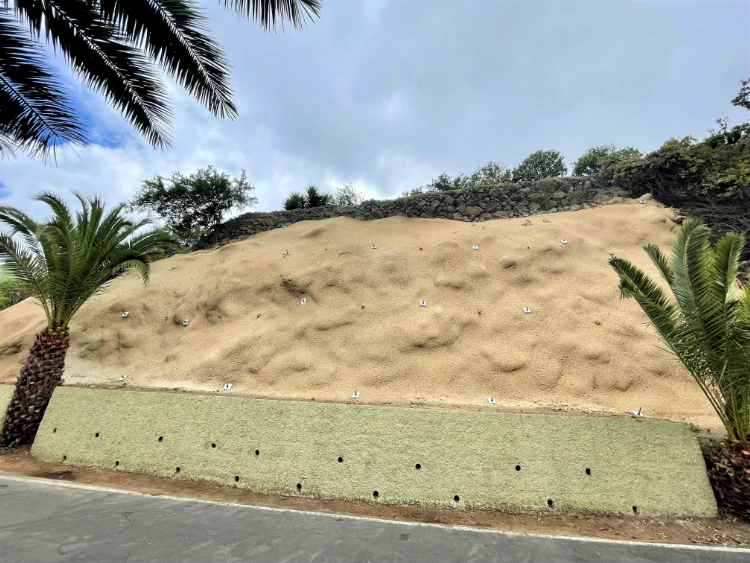
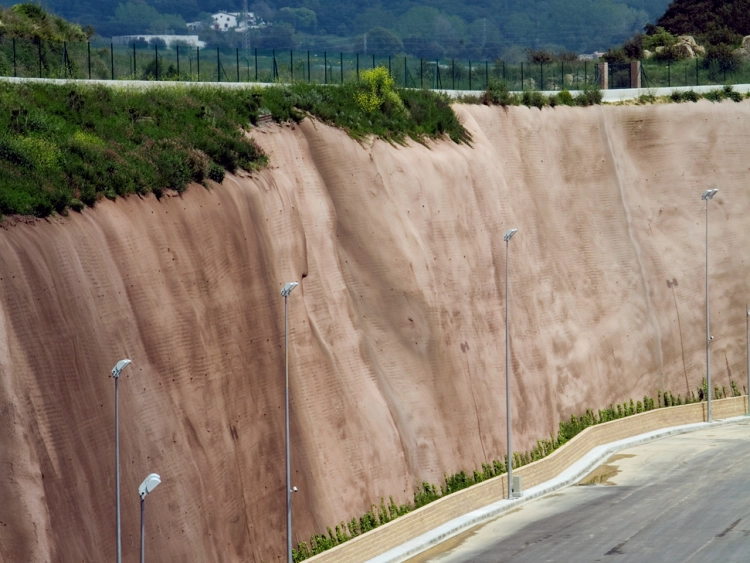
Soil Nailing projects
Soil Nailing projects
Frequently asked questions about Soil Nailing
Frequently asked questions about Soil Nailing
What is soil nailing?
Soil nailing is a technique for reinforcing excavated slopes with closely spaced anchors, welded mesh and sprayed concrete. The ground itself is reinforced from within, so that it behaves as a stable reinforced mass while the excavation continues.
The name is descriptive: the anchors of the system are known as soil nails, high-strength steel bars that are grouted and placed close together to reinforce the ground from the inside. The same technique is sometimes called ground nailing, and the finished face is referred to as a nailed wall or soil nail wall.
In projects and on site, the English term is used internationally, including in Spain. In all cases, it refers to the same reinforcement system, which is built from the crest to the toe of the slope as the excavation advances.
At Solutioma, what matters on each project is the design: we study, size and carry out each solution according to the characteristics of the ground. If you have an excavation of considerable height, you can consult us with no obligation.
When is Soil Nailing used on slopes?
Soil Nailing is used mainly in large excavations resulting from major earthworks, where cut slopes of considerable height are created and have to be supported while the works are under way.
In building, it is used to reinforce excavated slopes for basements, car parks and other excavations. In civil engineering, it is used to stabilise and reinforce cut slopes on roads, superstructures and tunnels, and it can also form part of slope remedial works.
More than the type of project, what determines its suitability is the behaviour of the ground: the face must remain stable long enough to complete each phase of anchors, mesh and shotcrete. The system adapts to a wide range of soil types and geological conditions, and its design is based on the geotechnical properties of the area.
As well as stabilising the slope, Soil Nailing improves the safety of operatives working at the foot of the slope. If you send us the geotechnical report, our technical department will analyse whether it is the right solution for your project.
What is the soil nailing process?
The soil nailing process advances from top to bottom, at the same pace as the excavation: at each level, the anchors are installed, the welded mesh is placed and the concrete is sprayed before the next level is excavated.
First, the ground is drilled and the high-strength steel bars, usually GEWI-type or self-drilling, are inserted and grouted; they will work mainly in tension. One or more layers of welded mesh are then installed on the face of the slope and the anchors are secured with their bearing plates and nuts.
Shotcrete is then applied in as many layers as necessary to cover the mesh and the anchor heads. With this cycle, the Soil Nailing system reinforces the slope from the crest to the toe and the face is never left unsupported for long, which explains one of the main advantages of soil nailing: short construction times and high output.
At Solutioma, we carry out the whole process with our own specialised machinery, from drilling to shotcreting, and we adapt our resources to the project schedule. Tell us your deadlines and we will propose an outline programme.
How does Soil Nailing differ from rock bolts?
Both techniques drill the ground and insert grouted steel bars, but their scope is different: rock bolts pin specific blocks or areas of a slope, whereas Soil Nailing reinforces the whole excavation face as an integrated system.
Bores and anchors are used to pin blocks of the rock mass, hold meshes or membranes and stop specific masses from moving, and they can be installed on their own. In Soil Nailing, by contrast, the soil nails are closely spaced over the whole surface and combined with welded mesh and shotcrete.
The timing of the work also changes. Soil Nailing is applied in phases while the excavation is carried out, on newly formed cut slopes; localised anchoring with rock bolts can be carried out on existing slopes as spot reinforcement.
The choice depends on the geology, the height of the slope and whether it is a new excavation or an existing slope. At Solutioma, we work with more than forty different techniques, which allows us to propose the most suitable one for each case, or to combine several, when we assess your project.
What is a soil nail wall?
A soil nail wall, or nailed wall, is the face that results from reinforcing an excavated slope with closely spaced anchors, one or more layers of welded mesh and sprayed concrete or shotcrete.
Unlike a conventional retaining wall, no independent structure is built in front of the ground: the ground itself is reinforced and starts to behave as a reinforced mass. The soil nails provide internal stabilisation, while the mesh and the shotcrete provide surface stabilisation of the face.
That is why a soil nailing retaining wall describes a solution that works from inside the slope. The characterisation of the anchors, the definition of the mesh and the composition of the shotcrete are set according to the characteristics of the ground, which is the basis of any soil nail design.
At Solutioma, we size each wall according to the geotechnical properties of the area and build it with our own specialised machinery. If you are considering this solution, we will prepare a proposal based on your project drawings.
How much does Soil Nailing cost?
The cost of soil nailing depends mainly on the area of the face, the length, type and density of the anchors and the layers of welded mesh and shotcrete required by the calculations. For this reason, it is not a fixed figure.
The excavation phases and the pace set by the project, the geotechnical properties of the ground, the presence of water and the necessary drainage, and access for machinery to the slope also play a part. Where the face is difficult to reach, rope access work may be needed, and this is also included in the assessment.
As a qualitative reference, our technical data sheet states that Soil Nailing involves considerably lower construction costs than conventional systems, because it reinforces the ground itself instead of building an independent structure, and it is carried out with high output.
If you are looking for soil nailing contractors, send us the location, the approximate dimensions of the excavation and, if you have it, the geotechnical report, and we will prepare a quote. You can also call us on +34 900 101 895 to discuss the project with our technical team.
Contact
Why entrust your Soil Nailing project to Solutioma?
At Solutioma, we study, design and carry out Soil Nailing solutions to support excavated slopes in building and civil engineering works, with people who have more than 30 years of experience in the sector, rope access teams and our own machinery.
If you would like to discuss any questions with our technical team or request a quote for your Soil Nailing works, please fill in the form below. If you prefer, you can also call us on +34 900 101 895; we will be happy to assist you.
- +34 900 101 895
Call us if you prefer - solutioma@solutioma.com
Write to us directly - Over 30 years of experience
Survey, design and execution with our own team and machinery - Offices in Spain and Romania
Lleida, Madrid, Canary Islands, Jaén, Gipuzkoa and Bucharest